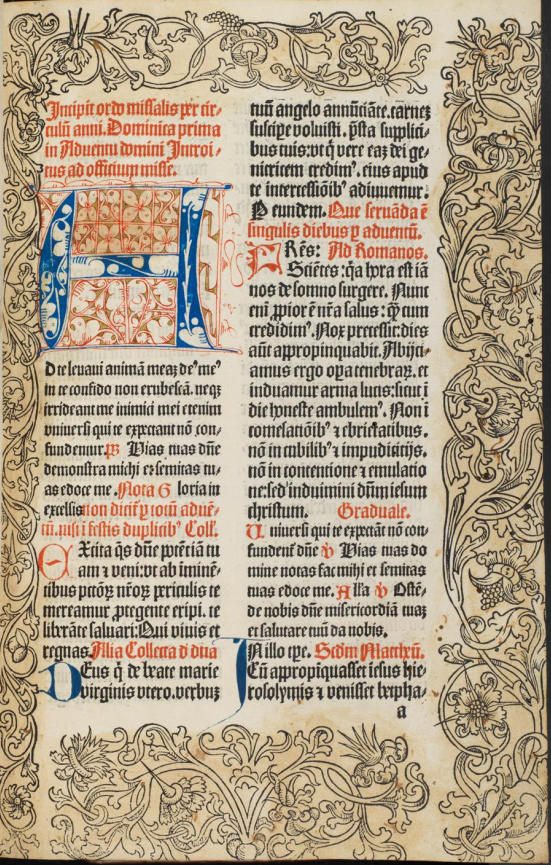
The Second Sunday in Advent
During last year’s field testing, I was able to put together some notes for each day in the first part of the liturgical year, and as we move toward the Second Sunday in Advent once again, I thought I would share a slightly expanded version of those thoughts from last year for those who weren’t field testing, or those who could use a refresher again this year. In addition to explaining one of our more unexpected (and wildly popular) editorial decisions, I hope the following remarks also give you some insight into the sheer volume of historical data being weighed throughout the decision making process.
Song of Songs 2:8b–14 / Romans 15:4–13 / Luke 21:25–33
Textual Notes
Somewhat unexpectedly, the predominating note in the appointed Gospel for the Second Sunday in Advent, Luke 21:25–33, is one of hope. While the signs and distress and fear preceding the return of the Son of Man will make the hearts of many fail for fear, these are, for the Christian, like the buds on the trees that signal the approach of summer—not a cause for fear, but an encouragement that the winter of sin is coming to an end and that He is on His way. Likewise, the Epistle from Romans begins and ends with hope, a hope that is given to us by means of Holy Scripture. The Church is encouraged to see these signs of destruction as reminders that the kingdom of God is near, that even though everything else may give way, His words and promises will never pass away. In the words of an often neglected stanza from Rejoice, All Ye Believers:
“It will not be much longer,
So slumber ye no more;
E’en now the trees are budding,
Fair spring puts out her flow’r
Foretelling times of quick’ning;
In ruddy evening skies
From far we spy fair morning,
And dark before it flies.”
This note of expectation is underscored by the newly appointed Prophecy for the day from Song of Songs 2:8b–14. For reasons discussed below, the Lutheran Service Book Prophecy from Malachi, with its language of “the Sun of Righteousness” and the imagery of calves bounding out from their stalls needed to be replaced. The newly selected reading from Song of Songs reflects the same notes of joy and hope that are found in the Malachi pericope and in the Gospel for the day, as Christ the Bridegroom is shown leaping upon the mountains, coming once again to His Church, and even now standing just out of sight. The imagery of spring and summer found in the Gospel is also seen in the Song of Songs pericope with a fig tree putting forth its fruit, and the note of eager expectation indicated in the Gospel is amplified still more.
A poem from Christina Rossetti draws the various strands together beautifully, together with some imagery from Matthew 25 (Trinity 27):
Passing away, saith the World, passing away:
Chances, beauty and youth, sapp’d day by day:
Thy life never continueth in one stay.
Is the eye waxen dim, is the dark hair changing to grey
That hath won neither laurel nor bay?
I shall clothe myself in Spring and bud in May:
Thou, root-stricken, shalt not rebuild thy decay
On my bosom for aye.
Then I answer’d: Yea.
Passing away, saith my Soul, passing away:
With its burden of fear and hope, of labour and play,
Hearken what the past doth witness and say:
Rust in thy gold, a moth is in thine array,
A canker is in thy bud, thy leaf must decay.
At midnight, at cockcrow, at morning, one certain day
Lo, the Bridegroom shall come and shall not delay:
Watch thou and pray.
Then I answer’d: Yea.
Passing away, saith my God, passing away:
Winter passeth after the long delay:
New grapes on the vine, new figs on the tender spray,
Turtle calleth turtle in Heaven’s May.
Though I tarry, wait for Me, trust Me, watch and pray.
Arise, come away, night is past and lo it is day,
My love, My sister, My spouse, thou shalt hear Me say.
Then I answer’d: Yea.
Historical Notes
One of the most significant changes in the lectionary in the last century has been the inclusion of Prophecies alongside the traditional Epistles and Gospels for Sundays throughout the year. Unlike the Sunday Epistles and Gospels, these Prophecies have yet to be standardized, and perhaps never will be. The appointed Prophecy in LSB for the Second Sunday in Advent was a very appropriate choice—but so appropriate that it had already been nearly universally appointed (by 49 of 53 sources) for the following Wednesday. As a result, a different Prophecy for this Sunday was required. There were substantially differing points of view on the reading from Song of Songs, as its imagery is so striking and somewhat unexpected in Advent. It was, without a doubt, one of the most discussed and debated assignments in the entirety of the temporal lectionary. This particular selection from Song of Songs is the historic Epistle for the Visitation.
The Epistle from Romans is attested in 68 sources with no deviations.
The Gospel attestation is nearly unanimous, with 63 sources prescribing Luke 21:25–33, including all of our sixteenth and seventeenth century Lutheran sources. There are 3 sources currently in our database that add verses 34–36, all of them American Lutheran sources: The Kirchen-Gesangbuch of the LCMS [“Walther’s Hymnal”], The Lutheran Hymnal (1941), and Lutheran Service Book (2006). The combination of the medieval and early Lutheran witness to the shorter cutting on Advent 2, together with the historic assignment of Luke 21:34–36 to the Friday of Trinity 10 by 47 of 49 sources, resulted in the provided pericope.
Discover more from The Lutheran Missal Blog
Subscribe to get the latest posts sent to your email.