Field Testing: Round 3
The editors of The Lutheran Missal are pleased to announce the beginning of our third comprehensive round of field testing, coinciding with the release of the newly-translated Sunday collects.
A new field testing page has been updated with the latest texts for the Readings, Psalmody, and Collects. Click here to sign up and receive the link, located at the end of the survey.
The Sunday collects of the church year are a treasure of the Western church, most of which trace to the Leonine, Gregorian, or Gelasian Sacramentaries (400s–700s). As such, these collects predate the problematic developments of the late-medieval period and clearly articulate the evangelical doctrine of the ancient, catholic and apostolic church.
The Lutheran Reformers retained the Latin Sunday collects, and they were republished both in Latin and vernacular languages for centuries following. (Lutherans did not move quickly or entirely to the vernacular—as late as the mid-1700s, the Latin collects could still be found in Lutheran prayer books and hymnals for the laity.)
Meanwhile, Thomas Cranmer, founder of the English Reformation, had translated the collects into English for the original edition of the Book of Common Prayer. Cranmer’s translations, though at times somewhat florid and expansive, were generally faithful, but later revisions of the BCP took rather greater liberties with the Latin texts. The evangelical sense of the original collects was often weakened, and, in a few egregious cases, brutishly disfigured. When the Lutheran liturgical tradition was being rendered into English in the Common Service of 1888, it was these altered forms that were in current editions of the BCP, and thus were taken up into the English-language liturgies of the Evangelical Lutheran Church, up to and including The Lutheran Hymnal (1941).
This is why the editors of The Lutheran Missal found it necessary to produce a fresh translation of the Sunday collects from the original Latin texts. However, we also found it necessary to keep one eye on the English texts that we have received (via the original BCP tradition), as these have been in continuous use among English-speaking Christians for the last 500 years, and particularly among Lutherans from the publication of the 1888 Common Service until Lutheran Book of Worship (1978) and Lutheran Worship (1982).
Here is the basic process we followed:
We divided the collects among twelve expert Latinists, who translated them from scratch without referencing any existing English rendering, so as to reduce any influence (intentional or otherwise) from existing translations. Our thanks are due to the following translators: Rev. Andy Richard, Rev. Dr. Benjamin Mayes, Rev. Chris Neuendorf, Rev. Dr. Eric Phillips, Mr. Eric Silver, Rev. Josh Hayes, Rev. Kyle Brown, Rev. Mark Preus, Mr. Matthew Carver, Rev. Paul Cain, Rev. Shawn Barnett, and Mr. William Cloninger.
The editors then compared the following sources and translations: the original Latin, the new Latin translations, German translations by the Lutheran reformers, Cranmer’s Book of Common Prayer, TLH, and any number of other existing English translations. Then we asked, “Does our received English text depart from the Latin in any significant way? If so, is it worth overturning the familiar language of BCP / TLH in order to restore what has been lost?”
In many cases, the differences were inconsequential—the choice of one synonym over another, or a matter of word order that had little effect on the overall meaning. When possible, we left the language of TLH intact, in keeping with Luther’s counsel to pick a version of a text and stick with it. No changes, for example, were made to the collects for the first three Sundays of Advent.
When it was necessary to alter a collect, we tended toward simplification. Cranmer’s prose, which is the basis for nearly all subsequent English translations (at least, outside of the Roman tradition), is often wordy, frequently rendering a single Latin word as two in English (hendiadys). Thus, “familiam” becomes “household and Church”, “protegendum” becomes “help and defend”, and “multiplica” becomes “increase and multiply.” Cranmer’s renderings, while fairly accurate, often lose something of the concise elegance of the original Latin. For example:
BCP (1549) / TLH (1941)— Epiphany 1:
O Lord, we beseech Thee mercifully to receive the prayers of Thy people who call upon Thee; and grant that they may both perceive and know what things they ought to do and also may have grace and power faithfully to fulfill the same.
The Lutheran Missal — Epiphany 1
O Lord, we beseech Thee mercifully to receive the prayers of Thy people who call upon Thee, and grant that they may both perceive what things they ought to do and also may have power to fulfill the same.
The petition in the above collect is twofold. We ask for perception and power. But this simple structure is obscured by the unnecessary doubling of each half of the petition.
In some cases we simplified the collect by removing entire phrases that were not part of the Latin text. For example:
BCP (1549) / TLH (1941)— Epiphany 3:
Almighty and everlasting God, mercifully look upon our infirmities, and in all our dangers and necessities stretch forth the right hand of Thy majesty to help and defend us.
The Lutheran Missal — Epiphany 3:
Almighty and everlasting God, mercifully look upon our infirmities and [] stretch forth the right hand of Thy majesty to defend us.
In a few cases TLH had adopted a corrupted version of the English text, and we were compelled by fidelity to the evangelical truth to restore Cranmer’s original translation of the Latin. For example:
BCP (1662) / TLH (1941)— Trinity 10:
O God, who declarest Thine almighty power chiefly in showing mercy and pity, mercifully grant unto us such a measure of Thy grace that we, running the way of Thy commandments, may obtain Thy gracious promises and be made partakers of Thy heavenly treasure.
BCP (1549) / The Lutheran Missal — Trinity 10:
O God, who declarest Thine almighty power most chiefly in showing mercy and pity, give unto us abundantly Thy grace, that we, running to Thy promises, may be made partakers of Thy heavenly treasure.
For those who are interested, a full catalog of changes from TLH can be found here, set side by side with the original Latin for comparison. This includes such changes as making reference to the Church as “she” rather than “it,” reordering some collects in accord with the original Latin, and restoring a number of historic collects not found in TLH. A handful of collects were rewritten in part or in whole.
Finally, we assigned collects to Trinity 25 and Trinity 26. These Sundays occur so infrequently that before the Reformation they had no propers of their own. Late medieval missals would simply give instructions following Trinity 24 to repeat the texts of a prior Sunday, or to say the masses for the Sundays after Epiphany that were not said earlier in the year, before proceeding to the Last Sunday after Trinity (“Dominica ultima”), noted in some earlier uses as the “Fifth Sunday before the Nativity”. The Lutheran Reformers assigned Gospel texts to these rare occasions (the Abomination of Desolation [T-25] and the Sheep and the Goats [T-26]), but they did not write or assign collects, and so the practice of repeating at least some of the propers from previous Sundays continued in some fashion up until TLH. Rather than writing new collects for these occasions (Lutheran Service Book does so, but we avoid outright innovation whenever possible), we found suitable collects from the broader corpus of ancient prayers in Corpus Christianorum (vols. 160–160H).
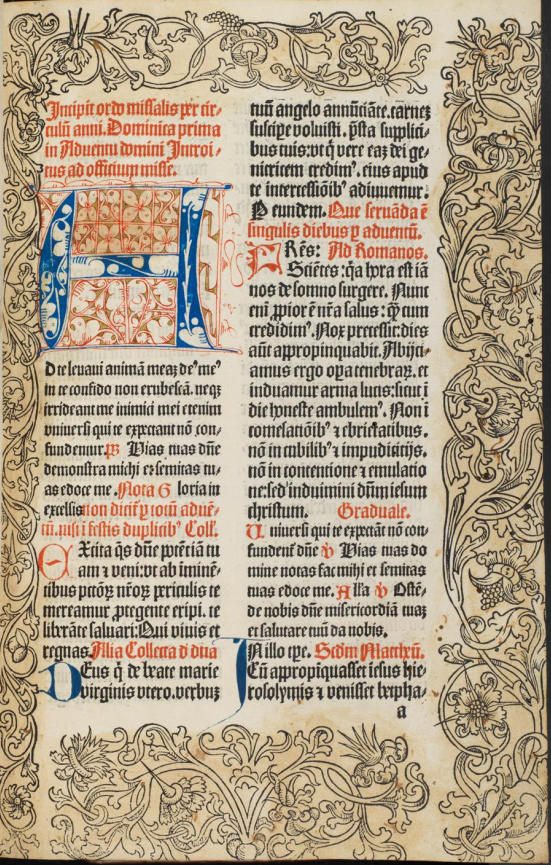
In some earlier iterations, Advent—sometimes called “St. Martin’s Lent”—was a seven-week season of fasting that began on the feast of St. Martin of Tours (Nov. 11). This became standardized as the four-week Advent that we currently observe, with the fast largely omitted, but echoes of its previous nature remain: subdued violet vestments and the omission of the Gloria in Excelsis in Advent, as well as the Excita prayers that characterize three Sundays (and Ember Friday) in Advent and the Last Sunday after Trinity. While the newly appointed collects were chosen from a dozen possibilities and were selected on their thematic merits, they ended up fitting beautifully into this scheme, both being orations that begin with Excita and having connections to this time of the Church’s year. The collect for Trinity 25 is no. 2551 in Corpus Christianorum 160C and was appointed in various earlier uses for Advent 1, first vespers of Advent I, and Trinity 25, 26, or 27. It has, in many ways, returned home again by being appointed for Trinity 25. The Latin text follows:
Excita, domine, potentiam tuam et veni et, quod ecclesiae tuae promisisti, usque in finem saeculi clementer operare.
The collect for Trinity 26 is no. 2556, and was appointed in various sources for, among other days, Trinity 24, either as a collect or super populum.
Excita, domine, tuorum corda fidelium, ut, sacris intenta doctrinis, et intellegant, quod sequantur, et, sequendo, fideliter apprehendant.
If you would like the translations of the aforementioned prayers….you should sign up for field testing. The complementary complends for these collects, which are not included in this year’s field testing, have a similar late-Trinitytide and Advent provenance.
It should be noted that while the Last Sunday after Trinity is invariably celebrated on the Sunday before Advent, Trinity 25 and Trinity 26 occur very infrequently, when Easter falls exceptionally early. As the newest Sundays of the Church Year, they were never intended to displace the far more ancient Sundays of Trinitytide, and the three-week skip to the end of the Church Year popularized by Lutheran Worship (1982) and still observed in some parishes seems to be entirely an innovation of the late twentieth century.
As mentioned above, we have first and foremost striven in these translations to be faithful to the original Latin texts, largely continuing in the trajectory of Cranmerian liturgical prose. To this end, when modifications have been deemed necessary, or when entirely new translations have been required by a lack of English-language precedent, we have endeavored to speak clear and recognizable English, avoiding unnecessarily contorted phrases that leave the hearer wondering exactly what the prayer said due to an excess of subordinate clauses, which can, as in this sentence, make for a great deal of confusion on the part of the hearer, and leave one wondering precisely what has been said, due to a multiplicity of words that were only ever intended for the eye and not the ear, and stand as a great impediment to memorization and internalization. We have also sought to use vocabulary that is prayerful and recognizably English, not a set of Latin cognates strung together with a handful of articles and prepositions, as is common in some traditions.
With the release of these Sunday Collects, we are especially eager to hear feedback from our field testers. We have tried to strike the proper balance between avoiding language that is overly archaic and overtly modern. As you pray these collects over the course of the next year, please do let us know if anything strikes you as sounding out of place. We will happily receive all feedback and consider further revisions to the texts. Sign up here to join us in this exciting new year of field testing!
Discover more from The Lutheran Missal Blog
Subscribe to get the latest posts sent to your email.
Regarding the collects for the Last Three Sundays, was the tradition of our German Lutheran brethren consulted? They observe the last three Sundays of the Church Year annually, so I imagine that they have fixed collects for the occasions. I wonder also if those passed into Brotherhood Prayer Book, which draws upon the usages of the German Lutheran church.