“Historic” Lectionary?
Recently we added three ancient lectionaries: Würzburg c. 700, Murbach c. 800, and Alcuin c. 800. A day may come when these important sources are properly introduced with a dedicated blog post, but it is not this day. Instead, this post will attempt to put forever to rest the notion that there is no such thing as a true “historic” lectionary, since “none of the ancient sources are in agreement.” This idea is not supported by the evidence.
The graphic below compares the Sunday Epistles of Würzburg, dated c. 700 (though it may be as early as 650 AD), with the dioceses of Late Medieval Germany and the post-Reformation Lutheran sources—including TLH (1941) and LSB (2006). Most of the sources are about a 95% match with Würzburg (49 out of 52 Epistles). Only a handful are less than 90%. The vast majority of these Epistles has been read among the churches of the catholic and apostolic faith for nearly 1,400 years. Clearly, the title Historic Lectionary has no further need of scare quotes.
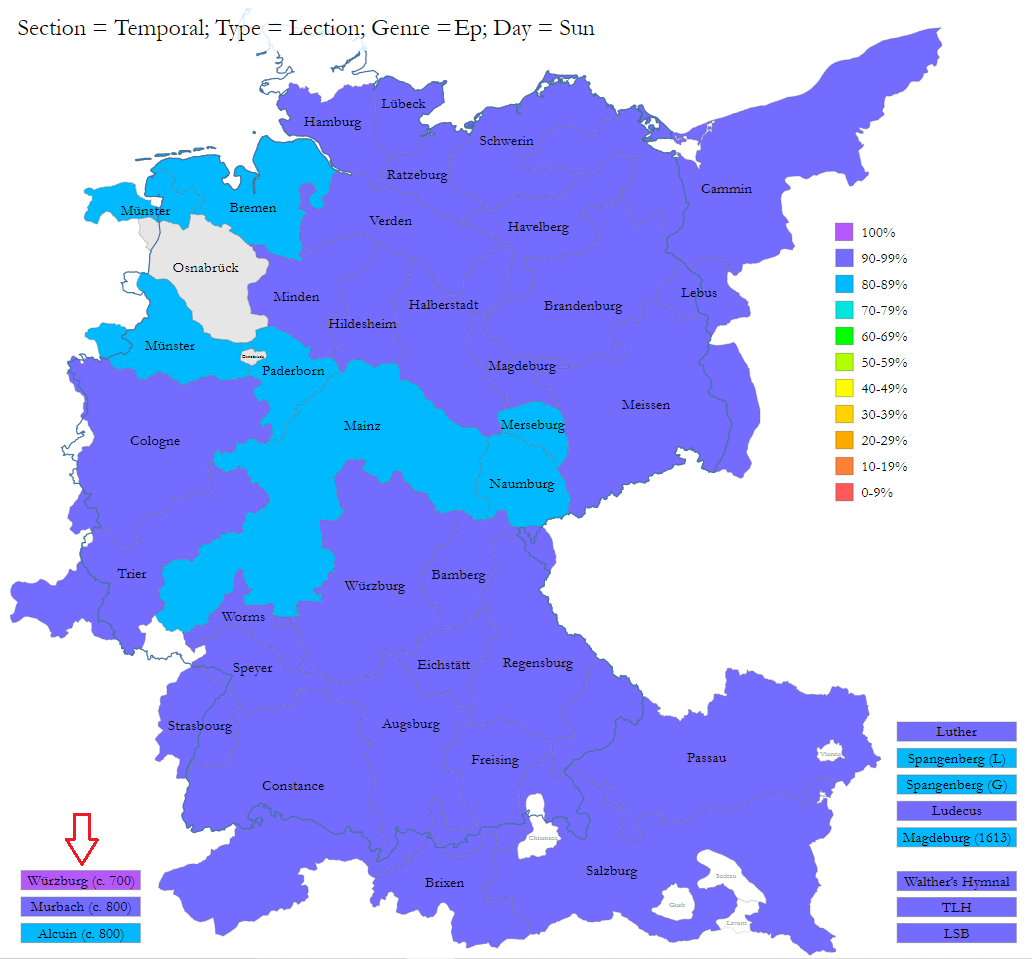
Note: The Gospels, for those who are curious, are just slightly less in agreement than the Epistles. Where there is a lack of consensus, it is generally found within Trinitytide. This season, especially its final Sundays, was fully established some time after the compilation of Würzburg c. 700.
Note II: Osnabrück is shown in grey because we lack a full missal for the diocese.
Discover more from The Lutheran Missal Blog
Subscribe to get the latest posts sent to your email.
I’m curious how these lectionaries line up with the granddaddy of them all, the “Comes” (i.e., “Companion”) of Jerome, or more accurately, Pseudo-Jerome. I’ve perused the “Comes” in Migne PLL 30, and it seems that this document from sometime in the fifth century lines up fairly well with the lectionary found in TLH, although I have not quantified that. While there have been a few changes since then (e.g., how to handle the last Sunday after the Epiphany), the lectionary has proven to be fairly stable.
Good question. There is some scholarly debate about the authorship and date of the Liber Comicus. The general consensus is that while the earliest surviving manuscripts are from the 11th century, its content likely goes back to the 6th century. We plan to add this source to our database in the near future. Though I haven’t examined it in detail, I expect it to be very similar to Würzburg and Murbach.
Evan, I am a classicist, not a liturgical scholar (except to the degree that every serious pastor must be a liturgical scholar) and thus know the work only from references in Luther Reed and similar sources. But my interest has been piqued. When you are ready to add that to the collection, let me know. I would love to contribute to this project. After all, I’ve told my students over the years, “That’s an interesting question. Why don’t you research the answer and report back to the class?” It’s only fair that I have to do the same after I’ve asked a question.
We would welcome your help James. I’ll send you an email.