Ashen Observations

With the beginning of Lent, Ash Wednesday (feria quarta in capite jejunii for you Latinists) rapidly approaching, it seems only appropriate to offer some suggestions on the mass for the day, as well as a rite for the blessing of the ashes.
American Lutherans have quite a diversity of practices for Ash Wednesday. The author, having attended Lutheran schools from preschool until the completion of seminary, has experienced a wide variety of practices within various churches and schools of our communion. These various practices invariably included ashes on the forehead, but everything that preceded and followed could vary immensely. Whether it was the nailing of paper scraps with scribbled sins to a cross, the burning of such pieces of paper, or, on one particularly memorable Ash Wednesday, first the former and then the latter, popular piety and peculiarity seemed to abound.
The Lutheran reformers seem to have encountered much the same sort of situation in their own day, though the questionable objects in question were, in fact, the ashes of Ash Wednesday. Matthäus Ludecus, dean of the Lutheran cathedral in Havelberg, wrote the following in his Missale:
And in particular, Christians on this day were formerly sprinkled with consecrated ashes by the priest, with these words: Remember, man, that you are ash, and into ash you shall return. But since at last vain superstition and abuse gradually crept into the churches, so that, the true use being subdued, absurd and ludicrous little ceremonies, such as the consecration of the ashes, and the hanging up of the Lenten veil, which they called the Jejunium, took first place, these absurd ceremonies (not undeservedly in this most glorious light of the Gospel) have been bidden farewell, those songs being retained which were not estranged from ancient purity, and it has pleased me to lay these before you…
Missale, Hoc est Cantica, preces, et lectiones sacrae, quae ad missae officium, ex pio primaevae Ecclesiae instituto, in templis Christianorum, cantari usitate solent, in communem Ecclesiae Dei usum et utilitatem collectae, ac in duas partes ordine distribute, 1589, fol. 60r, translated by Matthew Carver
Ludecus seems not to take issue with the imposition of ashes, regarding it favorably as one of those things that predated the “vain superstition and abuse” that were current at his time. The difficulty he has is with the consecration of the ashes, specifically that it, along with the hanging of the Jejunium or Fastentuch, had expanded and begun to take “first place.” Interestingly enough, in our project we have a glimpse of what Ludecus may have been writing about in 1589. The sixteenth century saw substantial liturgical changes brought on by the Counter-Reformation and the Council of Trent, and even prior to that by the influence of the Italian Renaissance drifting northward.
The rite for the blessing of ashes, as found in the late fifteenth and early sixteenth century Germanic missals, is fairly simple. There are a few collects, a handful of antiphons, and the imposition of ashes itself, all arranged in various different orders depending on the diocese, but generally concluding with the litany and sharing an 85%-90% agreement on the text of the collects and antiphons, no matter the order. But as the sixteenth century progresses, the rites begin to drastically expand, seeing the introduction in many places of the exorcism of the ashes, a practice otherwise quite uncommon in the sources consulted, with its few sparse appearances located largely in the southern portion of the Germanic dioceses. For example, the 1490 Bamberg Missal has the same collection of collects and antiphons mentioned above, as do the 1499 and 1507 missals from the same locale. But once we arrive at the 1587 Bamberg Agenda, we see a marked change. Before the usual collects, a threefold exorcism is added, and following the remainder of the usual collects and antiphons, a long series of suffrages is added, along with a few more collects and the seven penitential psalms before finally arriving at the litany, and then proceeding, after yet another antiphon, to the Introit.
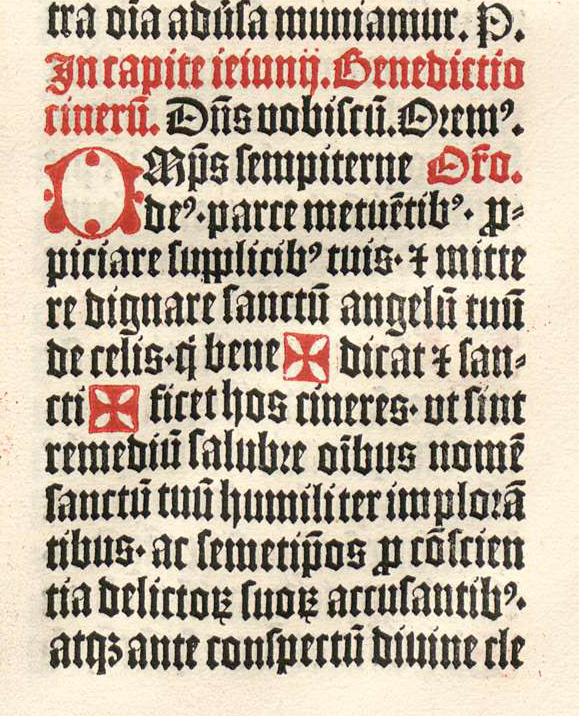
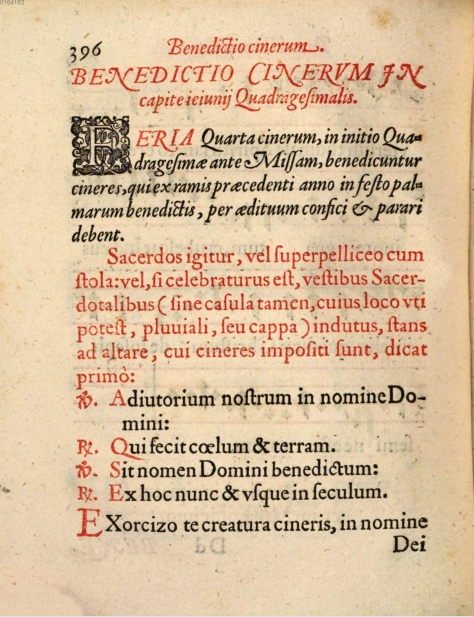
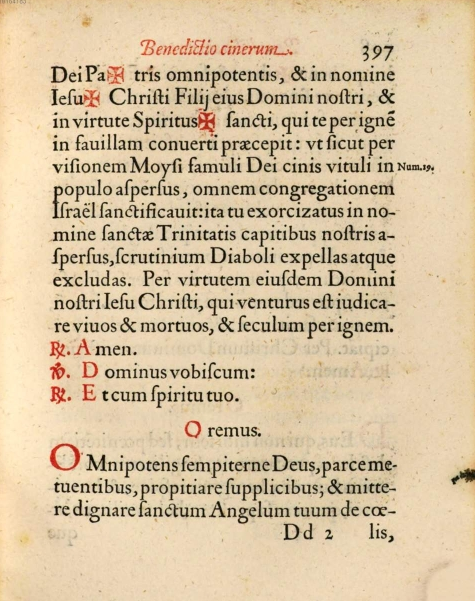
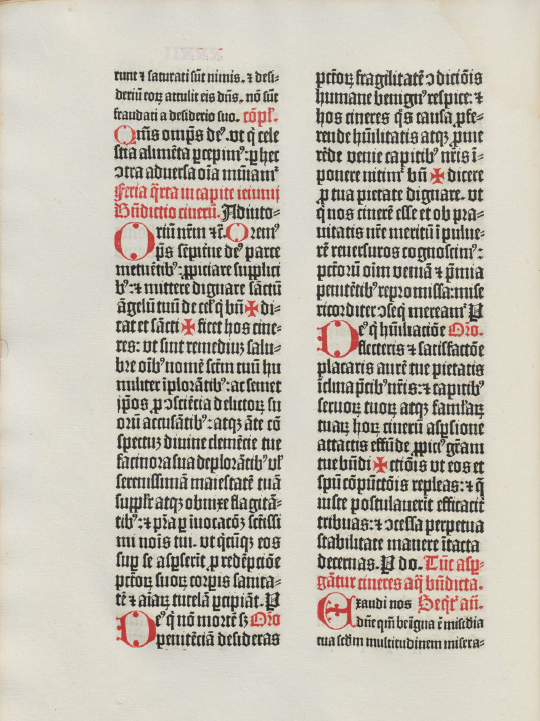
In the span of a century, the order for the blessing of the ashes in Germanic dioceses seems to have more than quintupled in length, almost certainly taking up more time than everything in the mass preceding the Preface. It is this latter rite, or something quite similar to it, that would likely have been in use at the time in which Ludecus wrote his Missale. It seems entirely possible that the “true use” to which he referred may have been something akin to that earlier rite, a use still within living memory.
And so, in the spirit of Ludecus, on this Ash Wednesday we hope to provide a way to observe the beginning of the Lenten fast with piety and reverence and without vain superstition and abuse, a way rooted in Holy Scripture and developed by the Church over the centuries.
As mentioned above, there is no unanimous consensus in the sources consulted on how exactly the rite for the blessing of ashes is to proceed. Nearly all of them have the same collects and antiphons, but there is some degree of variation in how exactly these elements are ordered. The order you find below is a consensus order drawn from approximately 25 books, and it most closely resembles Hildesheim 1499, Havelberg 1489, Cammin 1506, and, by pure happenstance (as it wasn’t one of the sources surveyed, but was only consulted after the conclusion of the research), Lund 1516. The collects have been very slightly amended to make them more evangelical in tone, and if the melodies provided for the antiphons are beyond the capacity of the musicians within the parish, a simple tone might well also be used for the text.
Many thanks to Matthew Carver for the translations of the collects, the typesetting, the notation for the antiphons, and the translation of Ludecus’ words above, and many thanks also to the reviewers.
After the Blessing of Ashes, the Divine Service begins with the Introit immediately following the Litany, the Gloria continues to be omitted, and the Creed is not said, as is customary on ferias. Apart from that, the service for the day proceeds as normal.
Discover more from The Lutheran Missal Blog
Subscribe to get the latest posts sent to your email.
I thank you men for this work. I wonder, and perhaps I have missed a discussion on it, but are you sure you don’t want to make use of traditional second person pronouns?
The plan is to eventually have both a KJV/Jacobean language edition and an NKJV version. For the sake of ease and to minimize confusion, only one version of this suggested rite has been released.
What a blessing to have this. Thanks so much
Thanks so much for this work. Here’s how one might adjust the excellent rite to an LSB sensibility: https://www.dropbox.com/s/3alqrjees94kyk3/Bulletin%2017%20February%202021%20Ash%20Rite.pdf?dl=0