Alleluias of Trinitytide
Of all the genres of liturgical Psalmody, the Alleluias have required the most editorial attention. Our sources generally agree concerning the Introits, Graduals, Communions, and Offertories, but not always so with the Alleluias, particularly for the latter half of Trinitytide. And the Alleluias of Easter? Fuhgeddaboudit. The map of the Alleluias for a given Sunday of Easter brings to mind the patchwork quilt of the Holy Roman Empire.
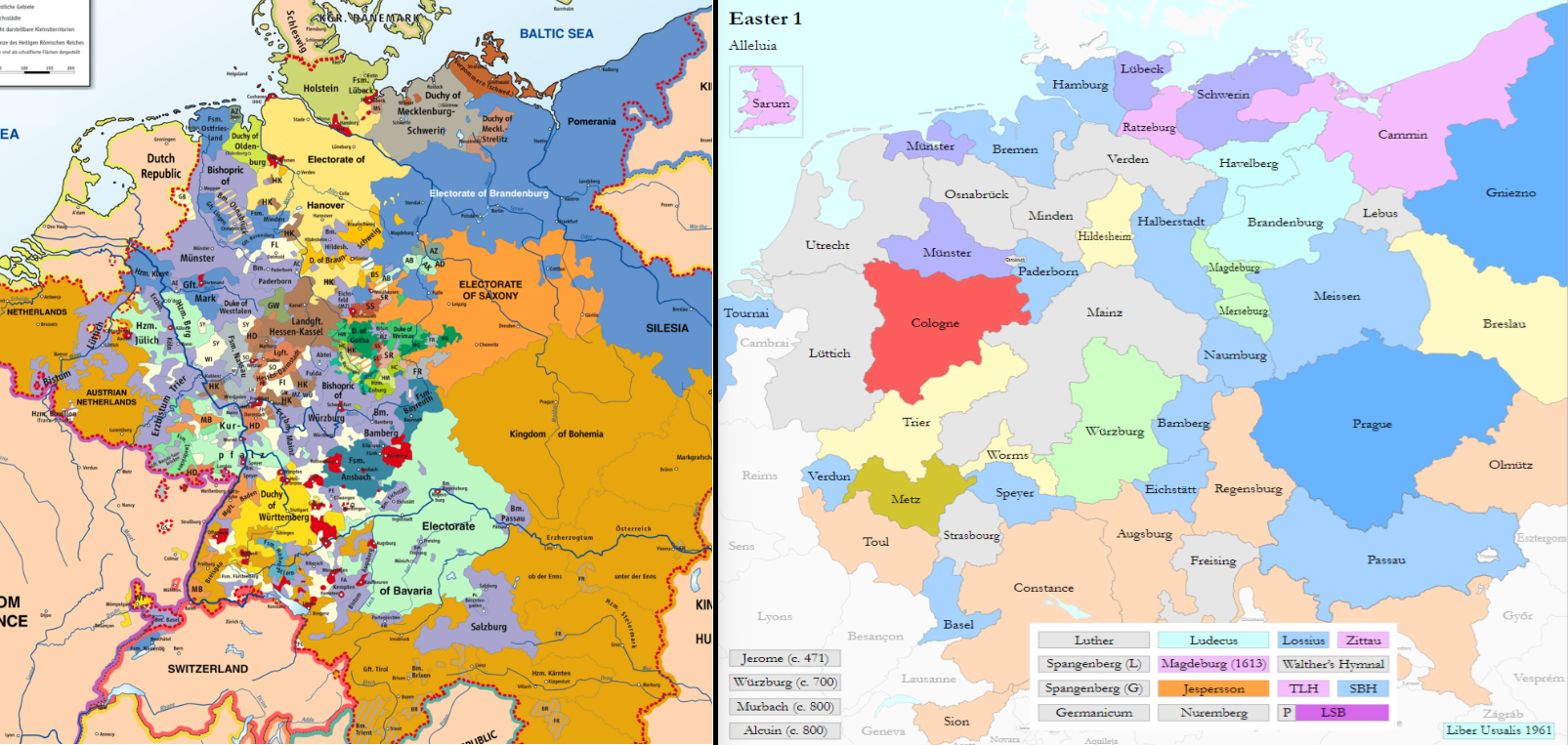
But I’ll write more on the Easter Alleluias another time; this post is about the Alleluias of Trinitytide—not quite as messy as Eastertide, but still enough to merit a lot of our attention.
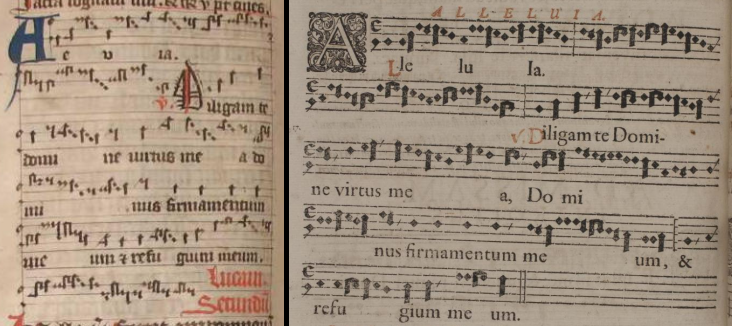
The editors of a certain recent hymnal were accustomed to picking out a favorite Bible verse, slapping an “Alleluia” at its beginning and end, and calling that an Alleluia Verse. But the historic Alleluias are much more than that. Each Alleluia was a unique composition based on one of the eight Gregorian modes. The Alleluias were fixed and familiar elements of the liturgy, each known by its own Latin name. The missals may not all agree, for example, that Diligam te Domine is the Alleluia for Trinity 3, but even across hundreds of years, all agree about what Diligam te Domine is. Note the nearly identical musical notation below from two very different sources: one a hand-written, pre-Reformation noted missal (circa 1425), the other a Lutheran office book from the early 17th Century.
The historic Alleluia verses for Trinitytide are not thematically aligned with the Gospel readings, as is generally the case during the festival half of the year. Rather, as the chart below exemplifies, they are assigned to the Sundays of Trinity in sequential order according to the numbering of the Psalter.
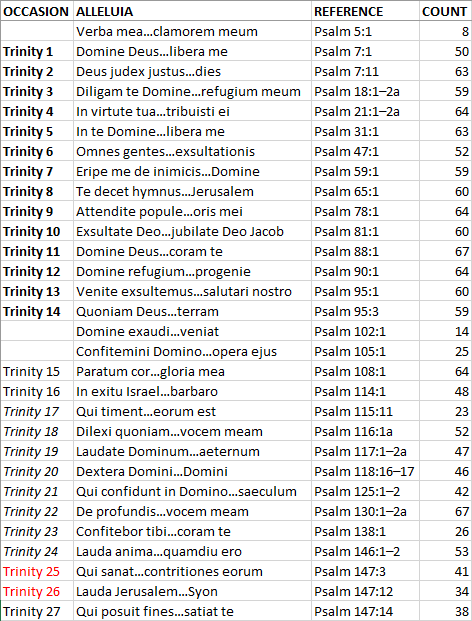
Once again, though our sources may disagree about which Alleluia should be sung on which day, all are drawing from the same pool of Trinitytide Alleluias, and all except one are following the basic sequence shown above. (Metz—obviously suffering from centuries of French influence—lacks any discernible pattern throughout the season of Trinity. Lund does follow the sequential pattern, but begins with Psalm 7:11 on Trinity 2.)
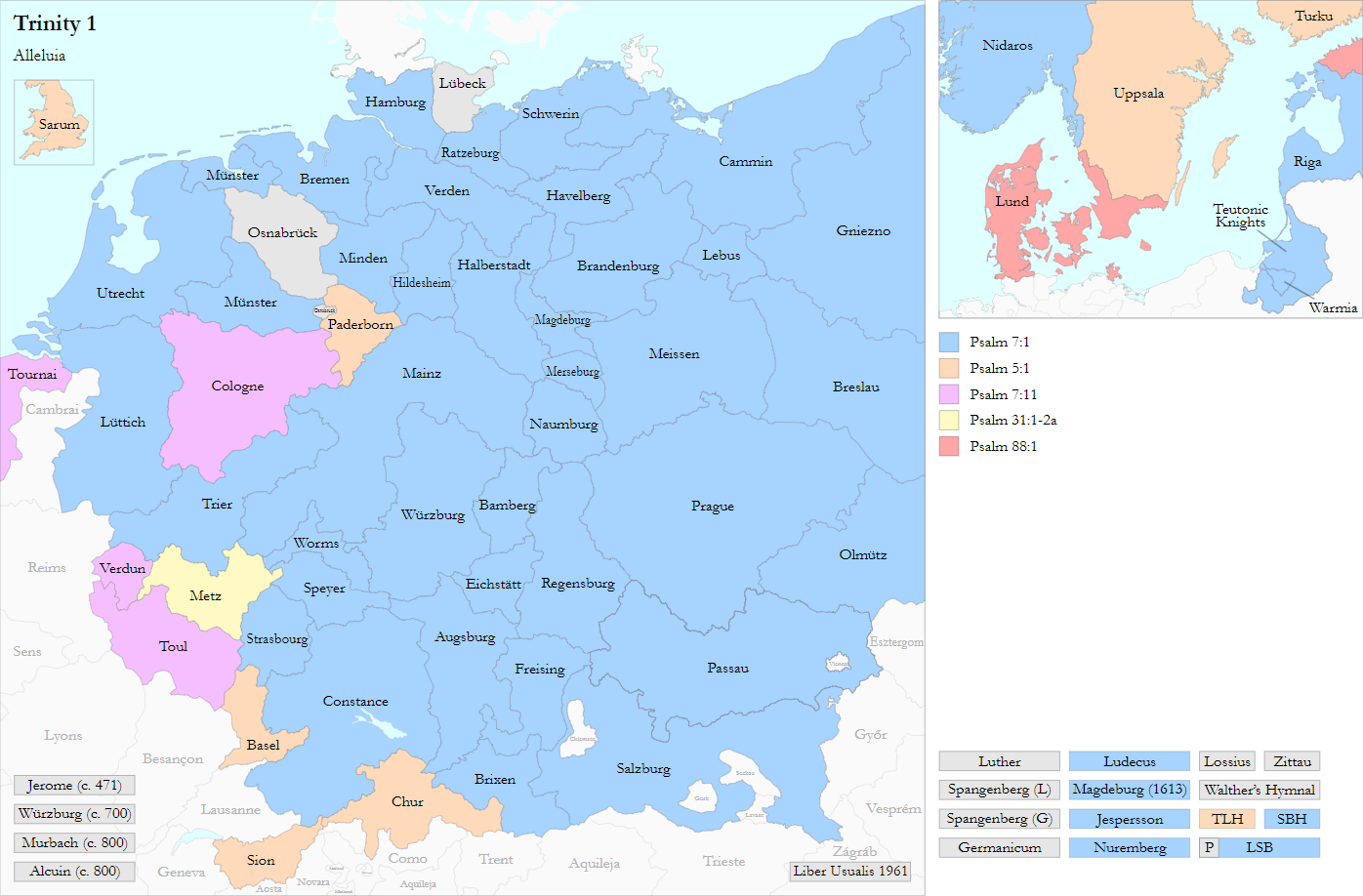
As can be seen above, the vast majority of our sources, including the Lutherans (bottom right), start the sequence with Psalm 7:1, while a small number, including TLH, begin either a week early or late. (TLH often aligns with the idiosyncratic liturgical texts of Sarum rather than the broad consensus of Germanic and Lutheran sources.)
Having largely begun with Psalm 7:1 on Trinity 1, every source (except Metz) then continues sequentially through the Psalter, arriving at or near Psalm 147:14 by the end of Trinity. But therein lies the problem. When does Trinitytide end? After as few as 22 or as many as 27 Sundays, though the latter instance is extremely rare. Some late medieval missals include propers for up to 25 of these Sundays, but most only up to Trinity 23 or 24. And so, as Trinitytide progresses with different end points in mind, the sequence of Alleluias drifts apart.
At Trinity 16, though there is still a clear enough consensus (27 sources, including the Lutherans), several different sub-traditions have emerged. Note that TLH (now joined by LSB) aligns once again with the Sarum/Anglican rite, now a week ahead of the majority.
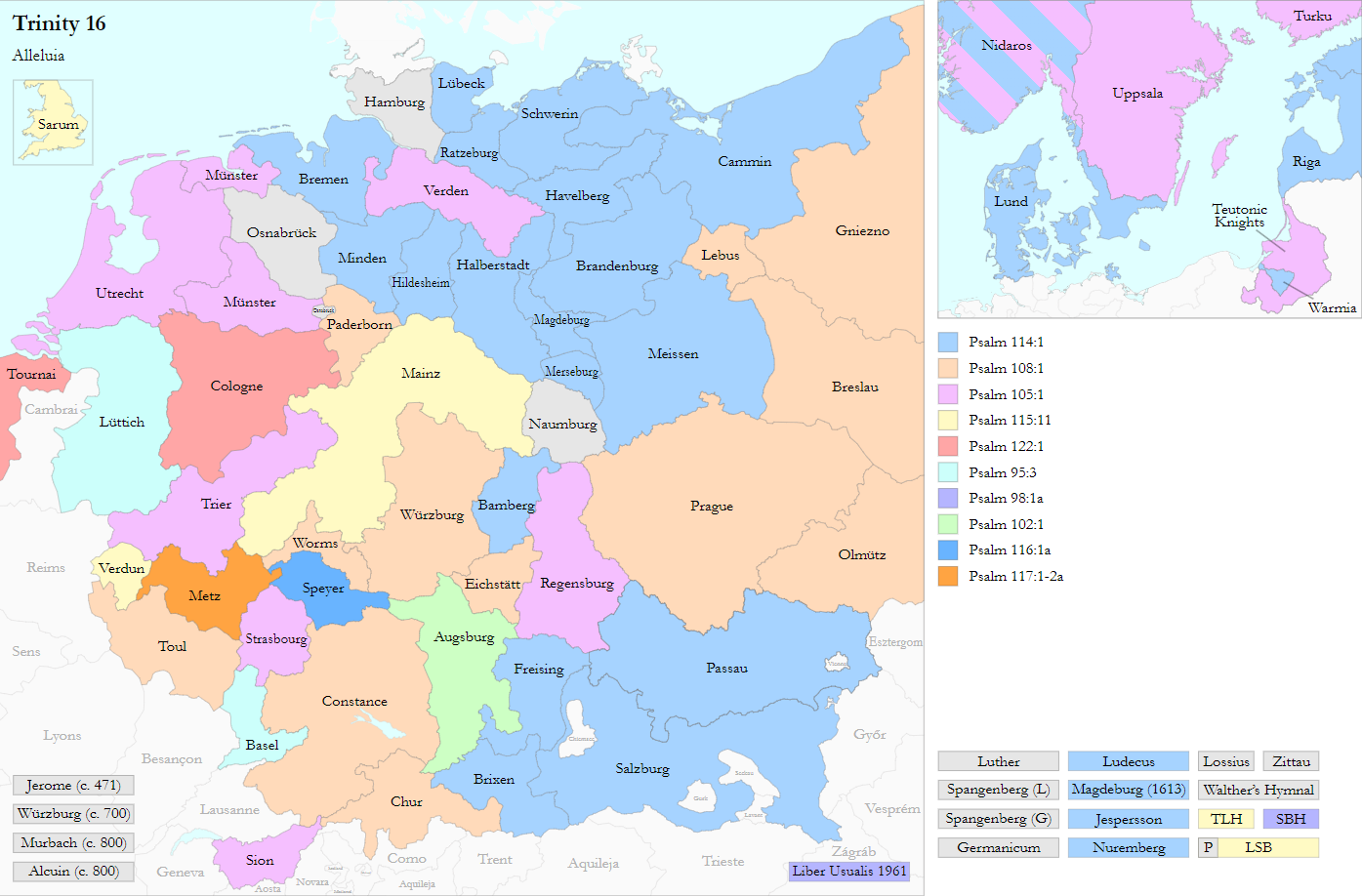
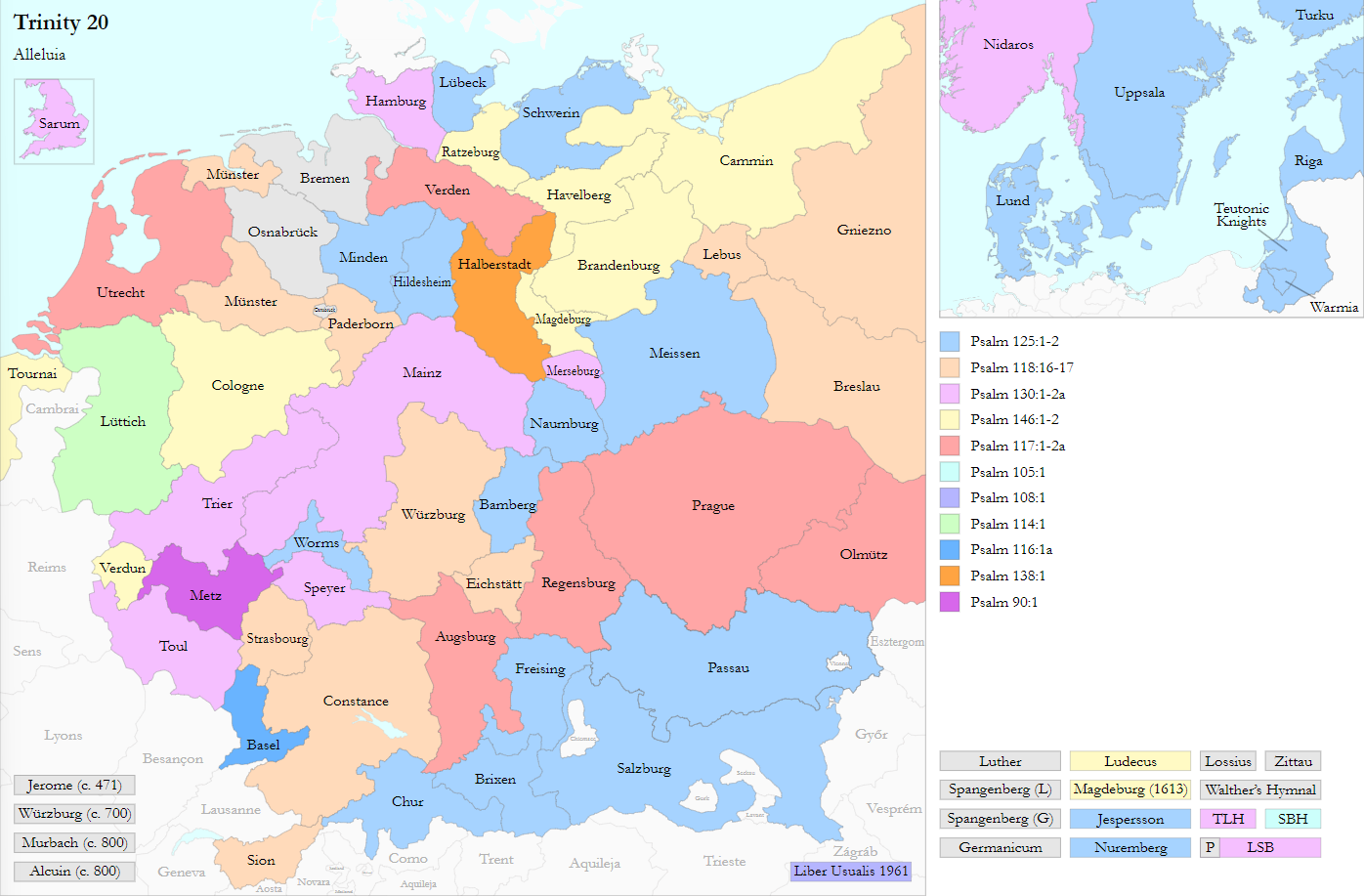
By the following week, even the Lutherans are in confusion. By Trinity 20, though every source (except Metz) is still following the same general pattern, the patchwork quilt is in full display. Among the Lutherans, Ludecus and Magdeburg are nearly at the end of the Psalter, while Jespersson and Nuremberg are three weeks behind.
So, how would we sort this out for The Lutheran Missal? Our editors determined to proceed with the following guidelines:
1) Use only the historic Trinitytide Alleluias.
2) Follow the sequential order of the Psalter.
3) Provide an Alleluia for all 27 Sundays after Trinity.
4) Follow the historic consensus as much as possible.
With those goals in mind, we returned to the pool of 30 well-attested Trinitytide Alleluias. We would need to use all except three.
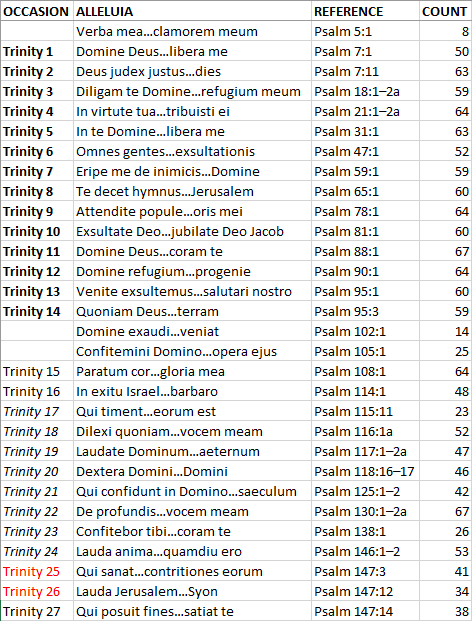
The first, Psalm 5:1, was the least attested of all (only 8 occurrences for any Sunday of Trinitytide across all sources). We passed over it and began, as do the majority of our sources, with Psalm 7:1 for Trinity 1. This strong majority held all through Trinity 14 (as shown in bold above.) At Trinity 15 and 16, as things began to fragment, we passed over Psalms 102 and 105, which were poorly attested, and continued with Psalms 108 and 114, respectively, which each held a slight majority on those Sundays.
Continuing forward from Trinity 17, we had exactly enough Alleluias to finish the year. Our assignments for Trinity 17–24, shown above in italics, are each a minority choice, but still within historic tradition. Most of these weeks are in sync with the Polish bloc (see Trinity 20 above), which was progressing more slowly through the Psalter.
Trinity 25 and 26 are shown above in red because there is virtually no historic data for these Sundays. As stated previously, the late-medieval missals only include propers for up to 25 weeks (Trinity 24 + Last Sunday). Trinity 25 and 26, which occurred very rarely, were simply called Vacant Sundays—if mentioned at all—and would borrow their propers from previous Sundays. After the Reformation, it was the Lutherans who first assigned unique readings (though not Alleluias) to these Sundays.
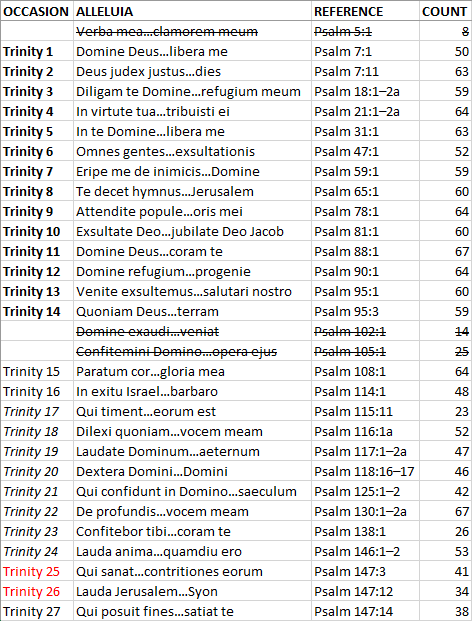
In summary, the editors of The Lutheran Missal believe that we have accomplished our objectives in assigning the Alleluias as printed in the chart (shown once more, below):
1) Only existing Alleluias for Trinitytide have been used.
2) The historical pattern which follows the order of the Psalter has been preserved.
3) Each of the 27 Sundays after Trinity has its own Alleluia.
4) The first 16 Sundays and the Last follow the majority tradition, and the remaining Sundays (excepting 2) follow an established, though minority, tradition.
Discover more from The Lutheran Missal Blog
Subscribe to get the latest posts sent to your email.