The Feast of St. Matthias
St. Matthias is an unusual apostle. He is never mentioned until he is chosen to fill the spot vacated by Judas. And then, having been “numbered with the eleven apostles,” Matthias is never heard from again. Some theologians are not certain that he should have been chosen at all. It was St. Peter’s idea, true, but Peter did not yet have the Holy Spirit. Could it be that Matthias was man’s choice, but St. Paul was God’s choice? Perhaps. Scripture seems to leave this question unanswered. At the very least, one must admit that the appointment of Matthias is unusual. Every other apostle was appointed directly by Jesus, but Matthias was appointed by… drawing lots? Certainly, God can work through means, but in the case of every other apostle, including St. Paul, He worked immediately, that is, without means.
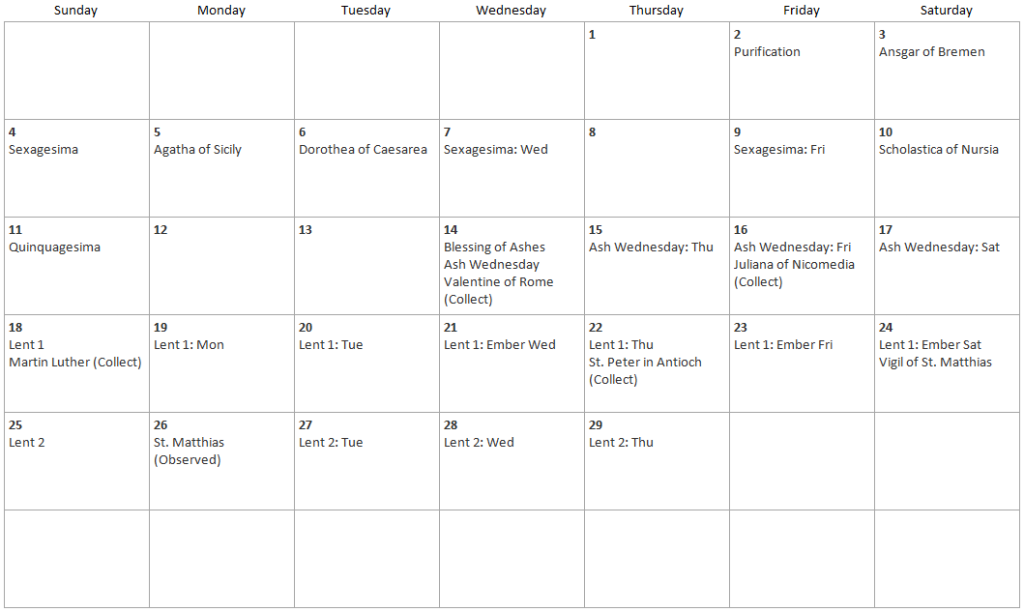
Perhaps it is fitting, then, that the feast day for St. Matthias would also be unusual. Just as there can be two opinions concerning his apostleship, so there can be two dates for his feast. St. Matthias is the only apostle whose feast day is not fixed to a specific calendar date. Instead, his feast occurs six days (inclusively) before March 1st. Most of the time, St. Matthias’ day falls on February 24th, but this year, being a leap year, it falls on February 25th. (Naturally, the same logic also applies to the Vigil of St. Matthias.)
So, this year we celebrate the Feast of St. Matthias on the 25th? Yes, but no. Because the 25th is also a Sunday, and because the Sundays of Lent take precedence over the feast day of an apostle, St. Matthias, which usually falls on the 24th, but this year falls on the 25th (Sunday), is celebrated on the 26th (Monday). Isn’t this fun? His vigil, however, which is usually on the 23rd, but this year falls on the 24th (Saturday), is not postponed. Therefore, those who wish to follow the historic observance of the Feast of St. Matthias this year will celebrate his vigil this Saturday and his day on Monday.
If we consider St. Matthias within the immediate context of the Church Year, things get even more interesting. The Gospel text for Reminiscere (Second Sunday of Lent) is Matthew 15:21–28, in which Jesus says to the Canaanite/Gentile woman, “I was not sent except to the lost sheep of the house of Israel” (Mt 15:24). And what is the Gospel text for the Vigil of St. Matthias, read the night before? Jesus sent out the twelve and commanded them, saying: “Do not go into the way of the Gentiles, and do not enter a city of the Samaritans. But go rather to the lost sheep of the house of Israel…” (Mt 10:5–8).
This beautiful pairing of the two texts can be no accident, since the vigil and feast of St. Matthias will generally coincide with Reminiscere—usually in the week or weeks prior, or, when Easter is earliest, in the week following. In the latter case, the sending of the twelve to the lost sheep of Israel serves as a reflection upon Reminiscere, but most of the time, it sets the stage for Jesus’ treatment of the Canaanite woman.
Our fathers knew what they were doing when they appointed the texts for the Temporal and Sanctoral calendars. They considered the seasons in which the feast days of the saints would fall year after year. And these considerations were not done in a moment, but across centuries of pious living according to the rhythm of the church year. Generations of thought and godly wisdom account for the ways in which the Historic Lectionary as a whole teaches the faith line upon line, precept upon precept, weaving all the strands of Scripture into a single, glorious tapestry.
Within living memory, only the Sundays and a few select feasts of the Historic Lectionary have been observed in our churches. But as we work to recover the mid-week Temporal occasions and a more robust observance of the Sanctoral calendar, it is certain that we will discover other gems such as this pairing of Reminiscere and the Vigil of St. Matthias. And then, perhaps, we will gain a fuller view of the rich tapestry we have inherited from our fathers, a tapestry in which every carefully woven thread points to Christ. Other questions aside, St. Matthias would certainly be in favor of this.
Discover more from The Lutheran Missal Blog
Subscribe to get the latest posts sent to your email.