Cartographic Advancements
We’ve added a new tool to the missal database: the ability to visually represent the data for a given occasion on a diocesan map of late-medieval Germany. To illustrate the usefulness of this feature, consider the following list of gospel texts for Friday of Sexagesima:
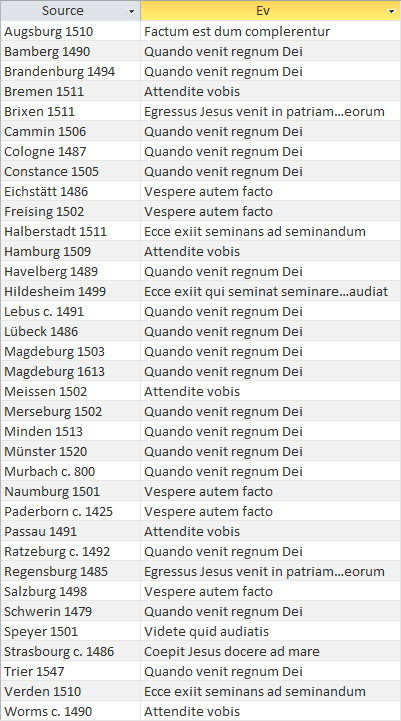
The chart above is an amazing amount of data to have at our fingertips, representing nearly two years of work. And while it does appear that Quando venit regnum Dei (Lk 17:20–37) is the most commonly assigned text, it is difficult to discern any sort of pattern beyond that. But now, we can view the same data presented as a map:
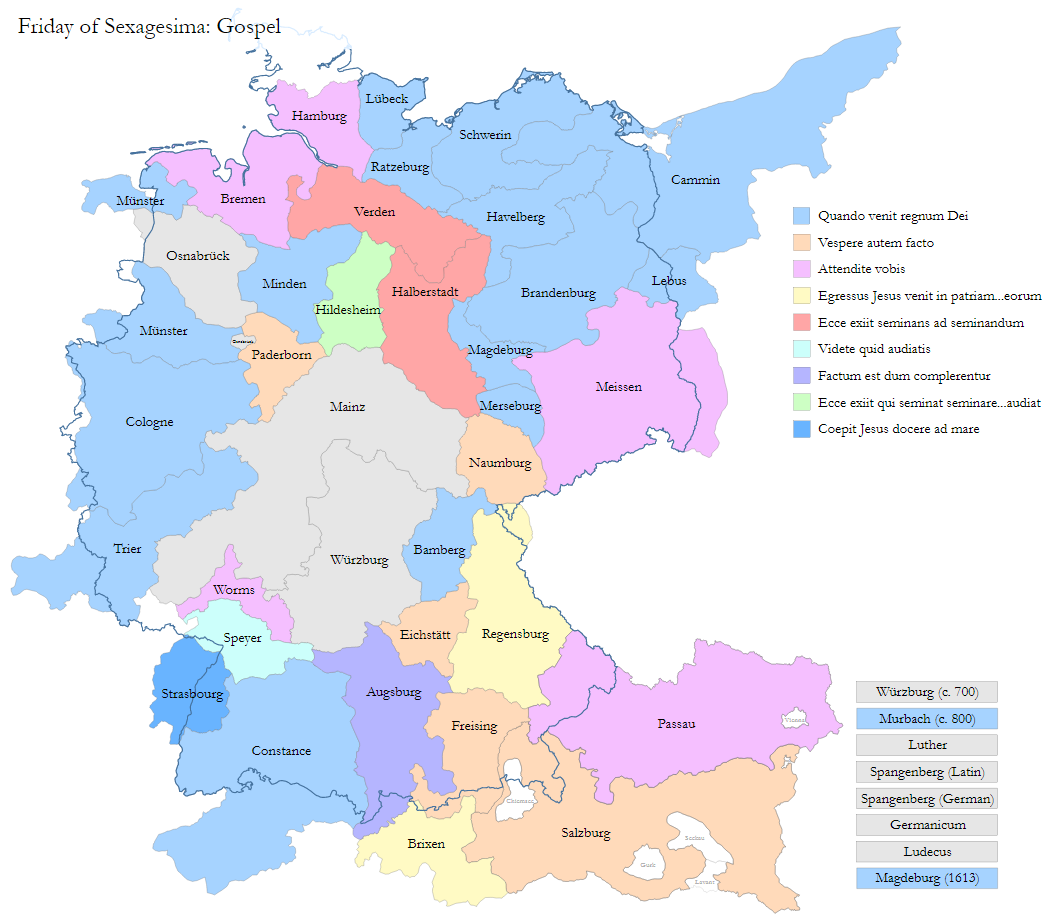
Across our sources (forty-four, at present), there are nine possible texts, listed in order of attestation. (The sources that do not provide a gospel text are shown in gray). As suggested above, Quando venit regnum Dei, is clearly the favored text, but now we can see more than simply a brute-force tallying of the numbers. Note that the north-eastern dioceses are in agreement. We have found this this to be typical. This corner of Germany tended to be more in sync with the older liturgical traditions and less adoptive of late-medieval innovations as they made their way up from Rome. The fact that this area of Germany most heartily embraced the Reformation gives these sources further weight.
At the bottom right of the map, the non-diocesan sources are listed. Most of these are post-Reformation Lutheran manuscripts, such as the great Magdeburg cathedral book, but the first two are uniquely important: Würzburg and Murbach, the two oldest western lectionaries known to exist. Most of our sources are around 500 years old; these two are approximately 1,200 years old! (The procurement and study of these manuscripts deserves treatment in a future blog post.)
Looking at the map shows that, not only is Quando venit regnum Dei the majority text among the diocesan sources, its history of use extends back at least another 700 years (Murbach). Further, this text became the received tradition of the Lutherans (Magdeburg 1613). We may safely conclude that Quando venit regnum Dei is to be preferred as the gospel text for Friday of Sexagesima.
The colorful map above might lead some to conclude that there is no such thing as a truly “historic” lectionary, given the amount of variation that can exist for some of the minor occasions. However, the major occasions that form the backbone of the lectionary show amazing agreement. Pictured below is the Gospel for Sexagesima Sunday:
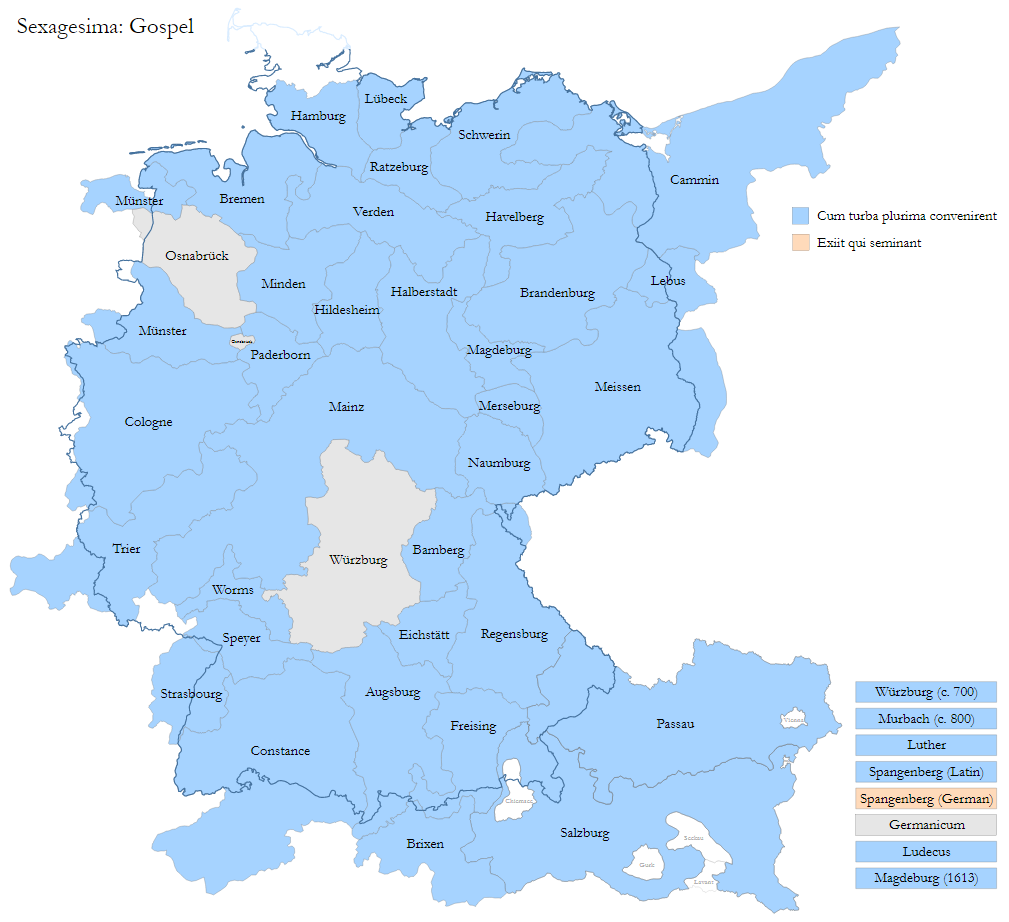
Here we see complete unanimity among our sources. Spangenberg might appear to be the lone exception, but it is actually the same text (the Parable of the Sower, Luke 8:4–15), only the German edition begins a verse later. Osnabrück and Würzburg (1490) are abridged missals with no entries for Sexagesima, and Germanicum, an ambitious Lutheran missal project of the late 16th Century, only contains Advent through Epiphany.
This example from Sexagesima is typical for the major occasions of the church year, showing the continuity of the historic lectionary from the present day back until at least 800 AD. (Beyond that we simply don’t have any records.) How the church could jettison this treasure in favor of a newly invented lectionary is beyond comprehension. But that is a subject for another day.
Discover more from The Lutheran Missal Blog
Subscribe to get the latest posts sent to your email.