The Nativity of the Blessed Virgin Mary
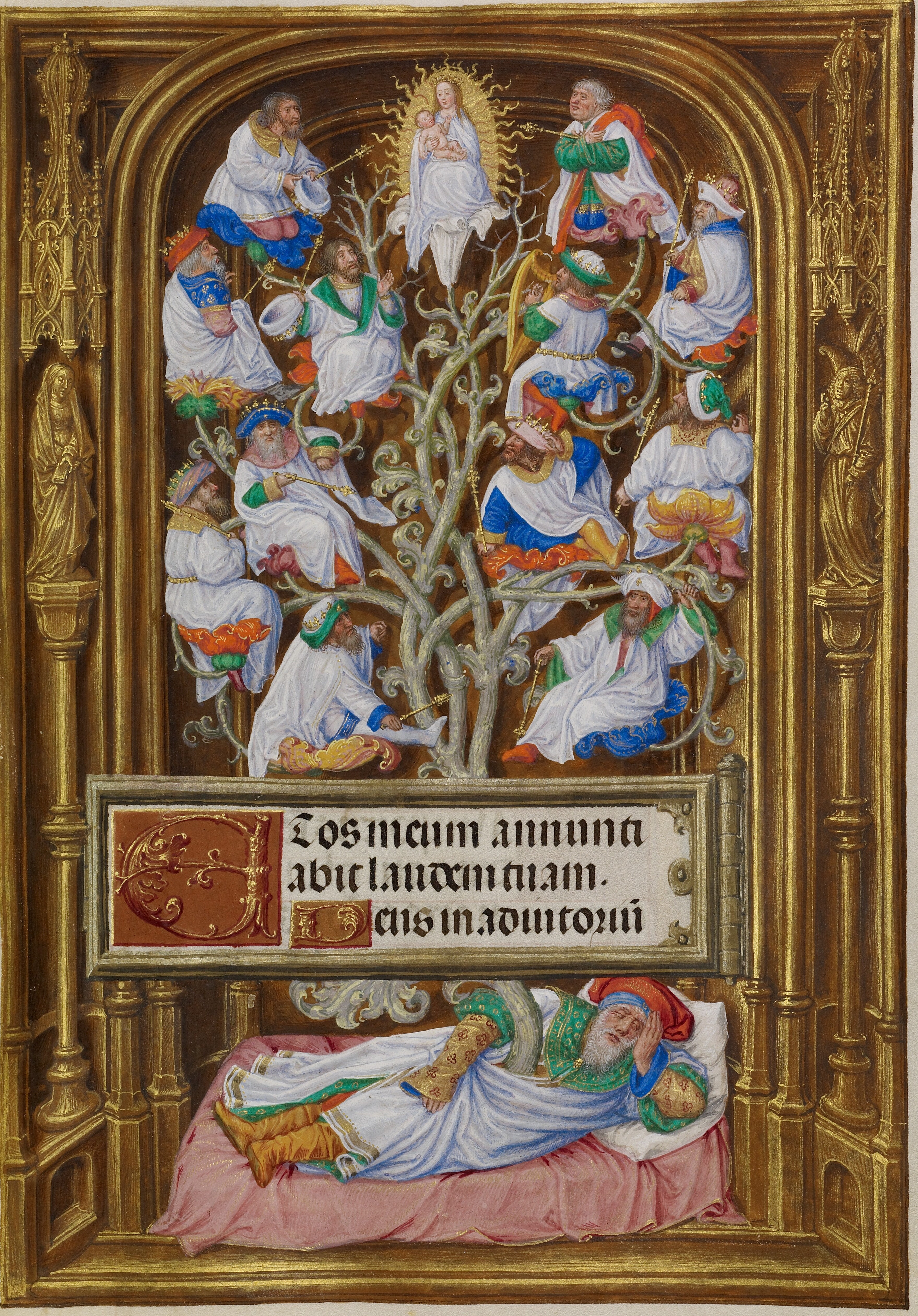
While the celebration of the Nativity of the Blessed Virgin Mary may be less than familiar to many American Lutherans, its observance is noted from the Gelasian sacramentary onward, appearing in medieval missals, Lutheran missals, Lutheran chant books, and Lutheran postils, as well as the hymnals and agendas of the Missouri Synod and Wisconsin Synod. When it falls on a Sunday, as it does this year, it outranks that Sunday. This, of course, presents something of a dilemma, as the usual resources that are currently available provide no guidance whatsoever.
Ludecus is happily helpful in this regard, suggesting Von Adam her so lange Zeit, found at no. 43 in Walther’s Hymnal, translated as “Since Adam’s age, so long have we” by Mr. Matthew Carver. Ludecus also appoints the monumental “O starker Gott, Herr Zebaoth,” a 38 stanza hymn not yet available in English translation, to the best of my knowledge [Edit: it’s here!]. You might well borrow from the daily office and sing Fit porta Christi pervia, Gaude visceribus mater, or another hymn from the common of the Blessed Virgin Mary as found in Liber Hymnorum or Brotherhood Prayer Book, such as Quem terra pontus. Most of these texts are in very common meters (though not necessarily in common meter), and can be sung to any number of familiar melodies if necessary. Quem terra pontus, for example, is well-suited to the melody Puer natus. In addition to these, a variety of Advent and Christmas hymns might well serve the purpose, and you could consult the suggested hymns for Purification (Feb. 2), Annunciation (March 25), Visitation (July 2), and Assumption (August 15) for further options. [Edit: If you have Lutheran Service Builder, search for “Jesse” in the hymn text field, and you will find a number of good possibilities, such as “Lo, How A Rose E’er Blooming”; “O Come, O Come, Emmanuel,” and so on.]
The readings for the day were largely unified in our sources, though there was some minor variation in the historic Epistle, with the majority of sources suggesting the Proverbs reading listed below, and others, among them the Missouri Synod and Wisconsin Synod hymnals, suggesting a reading from Sirach 24 instead. The Gospel was virtually universal, with only the Comes Hieronymi appointing the Gospel from the Visitation rather than the Matthew genealogy. In keeping with common modern practice, a third reading was added to the historic two, so the Proverbs 8 reading was renamed as the Prophecy, and the Galatians 4 reading from the Sunday within the Octave of the Nativity (“Christmas 1”) assigned as the Epistle.
The readings work together in harmony to present what is concisely presented in the Small Catechism: that Our Lord Jesus Christ is “true God, begotten from all eternity” (Proverbs 8) and also “true man, born of the virgin Mary” (Matthew 1). The novel Galatians reading draws these two together, explaining the necessity of the incarnation. The Matthew genealogy may seem like a challenge at first, as we are largely unaccustomed to preaching on — or even dwelling on — such things. A closer look, however, shows an immense and almost impossibly wide range of possibilities for meditation and preaching. The humanity that Our Lord assumes from His mother is colorful, to say the least. In addition to the expected patriarchs, we also hear “Judah, the father of Perez and Zerah by Tamar” (cf. Genesis 38), and “David was the father of Solomon by the wife of Uriah” (cf. 1 Samuel 11–12). The Opus imperfectum on Matthew is, I think particularly helpful while pondering these things. And without further prologue, the proper of the mass:
Introit – Gaudeamus omnes
Liturgical text; Psalm 45:1a
Rejoice we all in the Lord, celebrating the festal day in honor of the virgin Mary, at whose nativity the angels rejoice, and together praise the Son of God. ℣ My heart is inditing a good matter: I speak of the things which I have made touching the king. Gloria Patri.
Collect
O God, mercifully hear the supplication of Thy servants; that we who are assembled together on the Nativity of the Holy Virgin Mother of God, may by the intercession of Thy Son, our Lord Jesus Christ, be delivered from the dangers which beset us; through the same Jesus Christ, Thy Son, our Lord, who liveth and reigneth with Thee in the unity of the Holy Ghost, ever one God, world without end.
Prophecy
Proverbs 8:22–35
The Lord possessed me at the beginning of His way,
Before His works of old.
I have been established from everlasting,
From the beginning, before there was ever an earth.
When there were no depths I was brought forth,
When there were no fountains abounding with water.
Before the mountains were settled,
Before the hills, I was brought forth;
While as yet He had not made the earth or the fields,
Or the primal dust of the world.
When He prepared the heavens, I was there,
When He drew a circle on the face of the deep,
When He established the clouds above,
When He strengthened the fountains of the deep,
When He assigned to the sea its limit,
So that the waters would not transgress His command,
When He marked out the foundations of the earth,
Then I was beside Him as a master craftsman;
And I was daily His delight,
Rejoicing always before Him,
Rejoicing in His inhabited world,
And my delight was with the sons of men.
“Now therefore, listen to me, my children,
For blessed are those who keep my ways.
Hear instruction and be wise,
And do not disdain it.
Blessed is the man who listens to me,
Watching daily at my gates,
Waiting at the posts of my doors.
For whoever finds me finds life,
And obtains favor from the Lord.
Epistle
Galatians 4:1–7
Brethren: The heir, as long as he is a child, does not differ at all from a slave, though he is master of all, but is under guardians and stewards until the time appointed by the father. Even so we, when we were children, were in bondage under the elements of the world. But when the fullness of the time had come, God sent forth His Son, born of a woman, born under the law, to redeem those who were under the law, that we might receive the adoption as sons.
And because you are sons, God has sent forth the Spirit of His Son into your hearts, crying out, “Abba, Father!” Therefore you are no longer a slave but a son, and if a son, then an heir of God through Christ.
Gradual – Audi filia
Psalm 45:10a, 11a, 3b–4a
Hearken, O daughter, and consider, and incline thine ear: So shall the king greatly desire thy beauty. ℣ With thy comeliness and thy beauty set out, Proceed prosperously, and reign.
Alleluia – Virga Jesse floruit
Liturgical text
Alleluia, alleluia. ℣ The rod of Jesse hath blossomed: a virgin hath brought forth God and man: God hath given peace, reconciling the lowest with the highest in Himself, alleluia.
Sequence – Stirpe Maria or Ave præclara, as in Lutheran Sequences, nos. 36 & 43
Gospel
Matthew 1:1–16
The book of the genealogy of Jesus Christ, the Son of David, the Son of Abraham:
Abraham begot Isaac, Isaac begot Jacob, and Jacob begot Judah and his brothers. Judah begot Perez and Zerah by Tamar, Perez begot Hezron, and Hezron begot Ram. Ram begot Amminadab, Amminadab begot Nahshon, and Nahshon begot Salmon. Salmon begot Boaz by Rahab, Boaz begot Obed by Ruth, Obed begot Jesse, and Jesse begot David the king.
David the king begot Solomon by her who had been the wife of Uriah. Solomon begot Rehoboam, Rehoboam begot Abijah, and Abijah begot Asa. Asa begot Jehoshaphat, Jehoshaphat begot Joram, and Joram begot Uzziah. Uzziah begot Jotham, Jotham begot Ahaz, and Ahaz begot Hezekiah. Hezekiah begot Manasseh, Manasseh begot Amon, and Amon begot Josiah. Josiah begot Jeconiah and his brothers about the time they were carried away to Babylon.
And after they were brought to Babylon, Jeconiah begot Shealtiel, and Shealtiel begot Zerubbabel. Zerubbabel begot Abiud, Abiud begot Eliakim, and Eliakim begot Azor. Azor begot Zadok, Zadok begot Achim, and Achim begot Eliud. Eliud begot Eleazar, Eleazar begot Matthan, and Matthan begot Jacob. And Jacob begot Joseph the husband of Mary, of whom was born Jesus who is called Christ.
Offertory – Ave Maria
Luke 1:28b, 42c
Hail, Mary, full of grace, the Lord is with thee: blessed art thou among women, and blessed is the fruit of thy womb.
Preface – Of the Blessed Virgin Mary
It is truly meet, right and salutary, that we should at all times and in all places give thanks to Thee, O Lord, Holy Father, Almighty, Everlasting God: And with exulting souls to praise, bless and proclaim Thee on the Nativity of the Blessed Ever-Virgin Mary; Who by the overshadowing of the Holy Ghost also conceived Thine only-begotten Son: and in the glory of abiding virginity gave forth to this world an everlasting light, even Jesus Christ our Lord: Through whom the Angels praise Thy Majesty: Dominions adore it, Powers tremble before it: The Heavens also and heavenly Virtues, together with the blessed Seraphin, in joint exultation glorify the same: With whom we beseech Thee, bid that our voices also may be admitted, evermore praising Thee and saying:
Communion – Diffusa est gratia
Psalm 45:2b
Grace is poured into thy lips: therefore God hath blessed thee forever.
Complend
Grant, we beseech Thee, O Lord, that the Sacrament which we have received on this yearly celebration, may afford us relief in this present life and in the world to come everlasting life; through Jesus Christ, Thy Son, our Lord, who liveth and reigneth with Thee in the unity of the Holy Ghost, ever one God, world without end.
Discover more from The Lutheran Missal Blog
Subscribe to get the latest posts sent to your email.
Ah, to see a rebirth of this feast in our time. For some, the end of summer is marked by Labor Day. For me, for some reason, it is more associated with the earthly nativity of the BVM. Thanks for this post. I’m struck by the thought that a case could be made for the appropriateness of the Sirach pericope, given that seems to be part of Missouri Synod tradition for this feast. In any case, thank you. And I do love that Preface.