Dominica Palmarum
As the perennials emerge from the ground around this time each year, so too questions concerning the reading of the St. Matthew Passion on Palm Sunday. Should the entire Passion be read or only Matthew’s account of the Triumphal Entry? Does the lengthy Passion reading infringe on the theme of Palm Sunday? Was the Passion moved to Palm Sunday because of infrequent attendance at mid-week services?
The answer to this last question is a simple and definitive “no.” Far from being a recent innovation meant to counter waning attendance, the reading of the St. Matthew Passion on the Sunday before Easter is an ancient custom observed almost universally by the Western Church as far back as the fifth century (Jerome c. 471).
The Procession of the Palms with the reading of the Triumphal Entry is a separate rite that developed some centuries later. (Many dioceses were fond of beginning the mass with an entry procession. Over time, as might be expected, some of these processions grew more elaborate, accumulating propers of their own. My colleague, Fr. Stefan, has an excellent piece on the history and Lutheran adaption of the Palm Sunday Rite.) By the dawn of the Reformation, the Palm Procession and the Mass were customarily observed back to back, each with its respective Gospel reading. The fact that the Sunday before Easter had by this time come to be called Dominica Palmarum illustrates the Palm Rite’s tendency to overshadow the Passion, not vice versa.
Given that the Passion reading is the proper Gospel text for the chief service of Palm Sunday (Magdeburg 1613 being a notable exception among the Lutheran sources), is there any historic precedent for omitting the Passion and reading the Triumphal Entry (Matthew 21) in its place? Why, yes, there is. The 1510 missal from the diocese of Augsburg gives this delightful rubric immediately before the Palm Sunday mass:
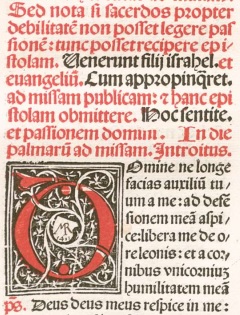
Roughly translated, the rubric instructs, “But note: if the priest, by reason of debilitation, is not able to read the Passion, then [Matthew 21] may be read instead, and the Passion of the Lord omitted.” Those pastors looking for a reason to skip the Passion reading this coming Palm Sunday now have a legitimate and historical reason to do so, but only—I hasten to add—insofar are they willing to admit to a state of debilitation. Otherwise, my counsel, based on the overwhelming consensus of fifteen centuries of church history, is simply to man up and read the Passion. Debilitation aside, there is hardly a more fitting way to begin Holy Week.
Discover more from The Lutheran Missal Blog
Subscribe to get the latest posts sent to your email.
One Comment