Why German Sources?

In the early days of The Lutheran Missal project, when we first began to catalogue the contents of the late-medieval missals, we choose to limit our scope to the German dioceses. These sources, show in blue below, roughly correspond with the territory of present-day Germany (outlined in green).

Several months ago, as we began editing the temporal calendar for The Lutheran Missal, we concluded that it was necessary to expand our sources into some of the surrounding areas. Though not within the borders of modern Germany, these dioceses were part of the German cultural sphere of influence, a.k.a. the Holy Roman Empire. We also added the arch-dioceses of Scandinavia and the English diocese of Salisbury (Sarum) for the sake of reference. The “expansion” sources are shown below in light brown. The map also includes four ancient lectionaries (bottom left), the earliest of which is believed to have been compiled in 471 AD, and the Lutheran sources (bottom right).
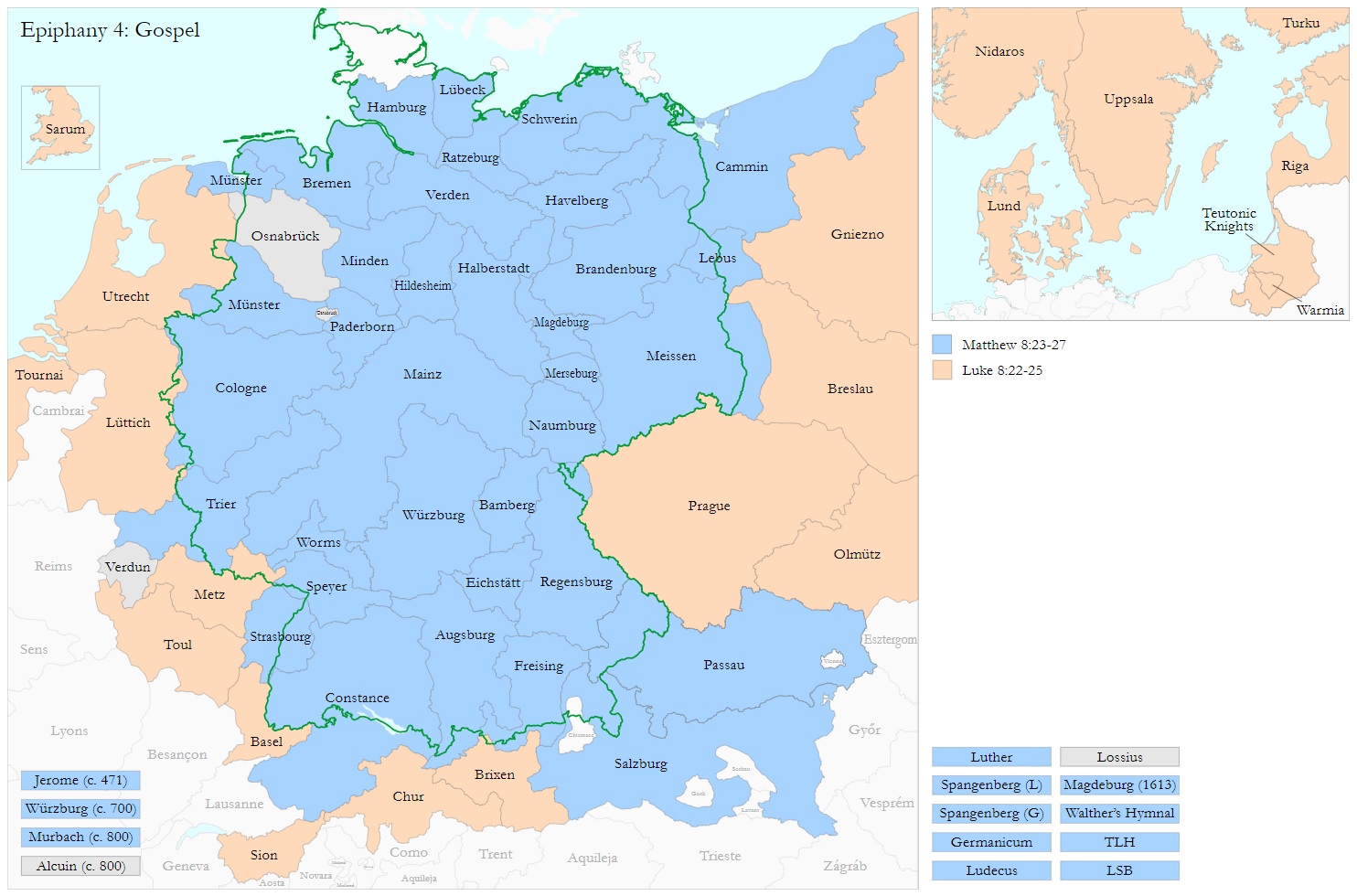
This map, which happens to show the division between our original German sources and the expansion sources, was not actually intended for that purpose. It is a representation of the Gospel reading for Epiphany 4. There are only two options, and each is widely attested: Matthew 8 (blue) and Luke 8 (light brown).

At first glance it might appear as though there are two conflicting lectionary traditions for this day, but a closer look would reveal that these passages are parallel accounts of the same event: the Calming of the Sea. This typifies that, though regional variations do exist, the attestation of the historic lectionary is surprisingly harmonious.

There is no doubt that the Calming of the Sea is the Gospel reading for Epiphany 4, but from which gospel? Matthew’s account is clearly to be preferred, as it has the witness of the most ancient sources (bottom left), the unanimous consensus of the late-medieval German dioceses, and the added witness of the early and late Lutherans.

Although not every case is as clear cut as the example above, it does illustrate and support our rationale for giving preference to the German-area dioceses: they are generally more aligned with both the ancient manuscripts and the post-Reformation Lutheran sources.


Discover more from The Lutheran Missal Blog

Subscribe to get the latest posts sent to your email.

Similar Posts

  • Medieval Manuscripts

    The missals of the late 15th and early 16th centuries present several difficulties to the curious but otherwise typical 21st-century reader. First, they are written in Latin, a language with no native speakers. Second, printing technology was still in its infancy, making the early manuscripts with their Gothic script and lack of white space difficult…

  • Alleluias of Trinitytide

    Of all the genres of liturgical Psalmody, the Alleluias have required the most editorial attention. Our sources generally agree concerning the Introits, Graduals, Communions, and Offertories, but not always so with the Alleluias, particularly for the latter half of Trinitytide. And the Alleluias of Easter? Fuhgeddaboudit. The map of the Alleluias for a given Sunday…

  • Volunteers Needed

    The second major phase of our research involves the entry of the sanctoral calendars into the Missal database. This is no easy task, since the average Sanctorale contains about 2,200 entries. (Multiplied by 34+ sources, this means over 75,000 records.) So far Augsburg, Bamberg, and Brandenburg have been completed, but the task took nearly 6…

  • The Whole Lectionary

    Many people do not know that Sundays and major feasts days are only a small part of the Church’s historic lectionary. These are the chief occasions, yes, but the lectionary, as observed by faithful Christians for centuries, includes much more. The temporal calendar historically contained propers for most Wednesdays and Fridays of the year, and…

  • Catholic Book Publishing

    Yesterday Monsignor Alan Detscher and I drove down to New Jersey for a meeting with Catholic Book Publishing. The Monsignor, recently retired, has been editing and publishing liturgical resources for decades. I met him by chance at a clergy association lunch, and he is very interested in The Lutheran Missal project. (His collection of Lutheran…

  • Field Testing Update

    In the two weeks since our initial request for field testing volunteers, we’ve been happy to receive nearly 150 responses. The map below displays the states in which clergy have signed up to use the temporal lectionary in congregational worship and provide feedback on a regular basis. As you can see, we have congregations in…

One Comment

Leave a Reply

Your email address will not be published. Required fields are marked *