The Propers, Part 2—The Sense of the Melodies
The previous article in this series discussed the texts of the Propers. While very important, the texts are only one half of the package. The present article will discuss the other half of the package: the melodies, specifically the historic Gregorian chants to which the Propers are sung in the Western Church.
The Propers as Music
In our contemporary minds, the music and the texts of the Propers are separate things. They are like a hymn text that may be sung to any of dozens of hymn tunes. But historically, the Proper texts and melodies were intrinsically linked—they were one single unit. Western musical notation was literally invented in order to notate the Propers, which had been sung from their inception. This can be seen in the first musical notation, an example of which appears here:

This manuscript from the Baylor University Library shows the Propers for the mass for Epiphany: The Introit Ecce advenit appears with a large capital letter so the musician can find the mass quickly. (Incidentally, one can see here the customary linkage between the Introit and the name of the occasion—to find Epiphany one does not look for “Epiphanium,” but for “Ecce advenit.”) The squiggles above the text are the musical notes—more properly, they are non-diastematic neumes (i.e., notes that appear without a musical staff, which are differentiated from diastematic neumes, notes that appear on a staff). This manuscript dates from the mid-twelfth century, so this is actually a rather late example of such notation (the first notes attached to staff lines appear around 1000 AD).
The indissoluble linkage between text and melody continued even into the era of polyphony, in which the traditional melodies were retained while additional voices were added. Here we see a three-voice composition by Perotin, the director of music at the Cathedral of Notre Dame in Paris around 1200:

This composition is a vertical expansion of the Alleluia for the feast of the Nativity of the Blessed Virgin Mary, Nativitas gloriose. The music is in systems of three staves. The chant melody is on the bottom staff of each system, in very long notes. The upper two voices dance above the chant in faster notes, illuminating and greatly extending the chant. This is but one of myriad examples of polyphonic settings of the Propers that were still intimately connected to the traditional melodies.
Only at the beginning of the sixteenth century did composers finally began to write freely-derived polyphonic settings of the Propers. However, they did not displace chant-based settings. As an example, see the Introit motet on Rorate caeli by Netherlandish composer Heinrich Isaac, writing at about the time Luther was appointed professor in Wittenberg:

The most obvious references to the chant melody are highlighted in yellow. The lowest voice carries the entire melody verbatim, just as it did in Perotin’s Alleluia setting, but now the counterpoint in the other three voices is derived from the chant as well. The chant truly permeates the musical texture. There are more subtle nods to the chant throughout the polyphony than are highlighted here, but to highlight them all would mean highlighting virtually every note in the piece. For the sake of comparison, here is the Introit Rorate caeli as it appears in Cantica Sacra (1613), the use of the Lutheran Cathedral in Magdeburg, p. 20, displaying almost note for note the exact melody used by Isaac in spite of it being printed 100 years later and 300 miles away:

All this does not mean that the Propers must be sung to one specific melody in one specific way, lest the singer be “doing it wrong.” Rather, it is to underscore that the Propers are musical by nature, and have always been understood that way. Furthermore, the historic melodies have been treated with respect by centuries of composers. As the phrase goes, “the medium is the message.” Throughout the history of the Propers, it has been the medium of music that carried the their message. Aside from not using the Propers at all, the closest one can get to “doing” the Propers “incorrectly” would be speaking them instead of singing them.
The History of the Melodies
The melodies to which the Propers of the Western rite have been historically sung are variously referred to as “chant,” “Gregorian chant,” “plainchant,” and “plainsong.” A full survey of the history of monophonic unaccompanied singing in the Church is beyond the scope of this article. We will restrict this discussion to a few salient points, the details of which the interested reader may find elsewhere. Suffice it to say for the moment that Gregorian chant is the music of the Western rite. It is inextricably bound up with the liturgy and its development. There is no other music that “sounds” so much like the Christian faith as Gregorian chant. There is a reason that even the documents of the Second Vatican Council gave chant pride of place. Even if we have other types of worthy sacred music now (e.g. polyphonic motets, chorales, and organ music) such that chant is not used, we nevertheless must acknowledge chant’s importance and ties to the liturgy, and we therefore should be willing to entertain its use. Of the significance of Gregorian chant in the liturgy, Mark Daniel Kirby writes:
The Missal, in fact, contains the very same texts found in the Graduale, but in the Missal they are printed without the musical notation that allows them to be brought to life in song and, in a certain sense, interprets them in the context of the liturgy. The melodic vesture of the texts functions as a liturgical hermeneutic, allowing them to be sung, heard, and received in the light of the mysteries of Christ and of the Church.
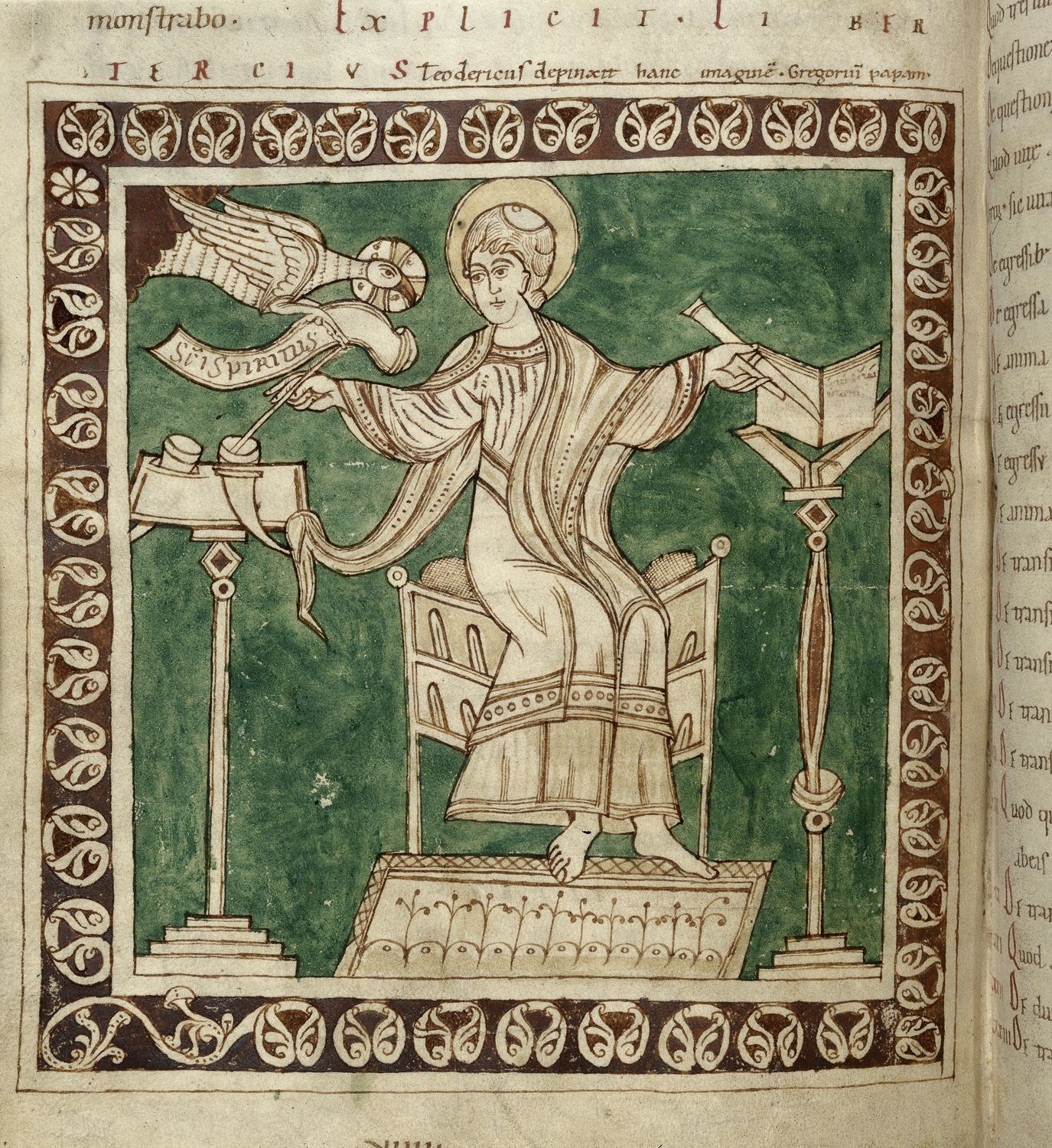
The moniker “Gregorian chant” denotes the influence of Pope St. Gregory the Great (r. 590–604), who is credited with the invention of this body of music. As the legend goes, which is emblazoned in all manner of artwork depicting him, including the illumination below, St. Gregory wrote down the chant as it was dictated to him by the Holy Spirit (which legend is demonstrably false, as vestigial Western musical notation would not be invented for another three hundred years). Nevertheless it is true that St. Gregory oversaw the compilation of the repertoire of chants to be used in Rome and arranged for the Roman Schola cantorum to sing it according to a prescribed standard, and in this sense it is reasonable for his name to be attached to the repertoire as a whole.

By the ninth century, various regional traditions of chant had developed in the Western Church, including Celtic (Britain), Mozarabic (the Iberian peninsula), Gallican (modern-day France and surrounding lands), Ambrosian and Beneventan (both Italian), and Roman chant (Rome, usually called “Old Roman chant“). Each of these chant repertoires differed considerably in character. As Rome asserted its influence over Europe, by the thirteenth century the predominant body of chant in Western Europe would come to be a synthesis of Old Roman chant and Gallican chant, and it is this synthesized repertoire that is most precisely understood to be “Gregorian chant.” This melodic corpus appears in all Western European notated missals, graduals, and breviaries from the High Middle Ages on.
Though the plainsong melodies themselves are remarkably consistent across Europe, differences are discernible in the written melodies from different regions. These “dialects” point to differing local customs and to the ways that different regions sang the chants and recorded the melodies. For the purposes of a discussion grounded in the Lutheran tradition, the most important dialect is the so-called “German dialect,” in which the note B is disfavored in certain contexts. Thus melodic formulae that appear with B or B-flat in sources from Gaul or Rome typically appear with that note moved up to C in more northern sources such as those from Paderborn or Magdeburg. The characteristic incipit found in Mode I Introits will serve as a clear example. In Da pacem Domine, the Introit for the Eighteenth Sunday after Trinity, we find this reading in Magdeburg 1613 (see especially first six notes, D-A-C, A-C-A; as well as the figure A-C-G on the rightmost syllable in the image):

And in the Liber usualis, which reflects the Roman tradition, we find this reading in which the Cs mentioned above are lowered to B-flats:

A Brief Excursus on Liturgical Books
The casual mention above of the various types of liturgical books requires a brief note on the names of the books in which these chants appear. The following therefore summarizes the necessary terminology for the foregoing discussion and subsequent articles. The interested reader may turn for details to the much more comprehensive survey by Andrew Hughes, Medieval Manuscripts for Mass and Office: A Guide to Their Organization and Terminology (University of Toronto Press, 1995).
- Gradual: contains the texts and melodies needed for the choir to sing the Proper of the Mass. Medieval graduals are quite large in format so as to be placed on a music stand and be legible by the whole choir, as the expense to provide graduals for each chorister would have been prohibitive.
- Kyriale: contains the texts and melodies needed for the choir to sing the Mass Ordinary.
- Lectionary: contains the lessons to be read at Mass. Though the lessons would be sung, lectionary volumes almost never set the texts to music, since the tones for the lessons are formulaic and would have been easily applied to the text by the subdeacon.
- Sacramentary: contains the collects for each Mass. Similarly to the lectionary, there was no reason to notate the collects, as the priest would simply apply the formula to the text on the spot.
- Missal: a convenient combination of the texts of the Gradual, Kyriale, Lectionary, and Sacramentary, which became universal by the thirteenth century. It holds all the texts needed to celebrate the Mass, including the ordinary, the propers, the lessons, and the collects. It may or may not be “noted:” that is, it may or may not include musical notation (in any of its developmental forms from the tenth through the sixteenth centuries) to allow for the chants to be sung straight from the missal. Noted missals represent a significant minority of missals.
- Antiphonal: contains the texts and music for the Office Propers.
- Hymnal: contains the texts and music for the hymns used in the Offices.
- Breviary: contains all needed texts to celebrate the Offices, including the contents of the antiphonal and hymnal as well as the collects, readings, and Office Ordinary.
- Liber Usualis: contains the needed elements to celebrate the most important days of the Tridentine Roman rite. The title is Latin for “book of common use” (or more casually, “the usual book”), and true to form it includes everything needed for Mass and Vespers on Sundays, major feasts, saints’ days, and all of Holy Week. (N.B.: the Liber Usualis is an early twentieth century volume of resources for the Tridentine Mass, which itself is merely the local use of Rome in 1570 that was mandated beginning in that year among the entirety of the Church that subordinated itself to the Roman pontiff. This took place decades after the Lutheran Mass had developed from the more northern liturgical practices prevalent in the Holy Roman Empire in the early sixteenth century. Thus, contrary to popular belief, the Liber Usualis is not a reliable historic source for Western liturgical practice, and it is most assuredly not an ancestor of the modern Lutheran liturgy, notwithstanding its “old-fashioned” appearance to our modern eyes.)
Dealing With the Sense of Boredom
We must address also the sense among the modern churchgoer that Gregorian chant is “boring” or “too long.” This perception is due to at least a couple of factors.
The first is the nature of the modern listener, who is not trained to listen to music in the same way as people used to be. Consider what Quentin Faulkner writes concerning the fundamental nature of art, with respect to music:
Which of the other arts exists primarily in time (as does music) instead of in space (e.g. painting, sculpture, architecture)? Beside music, the arts that exist primarily in time are literature, poetry and drama. (Dance is unique in that it exists equally in time and in space.) (Wiser Than Despair: The Evolution of Ideas in the Relationship of Music and the Christian Church, p. 149)
Thus art exists in either time or space (or a combination thereof, in the case of dance). Music and literature exist in time but not in space. For a listener to perceive music, therefore, time is required—perhaps a significant amount of time. While one can conceivably look at an entire painting in an instant, it is impossible to listen to an entire symphony in an instant, because it is necessary for time to pass in order for that art to be perceived. Literature enthusiasts are aware of this phenomenon with respect to that form of art: nineteenth-century English novels are written in what we today perceive to be an especially long-winded style. To fully appreciate these novels, one must be aware of that style, and be acclimated to experience that art as it exists. The situation is the same with chant: the modern populace is not able to listen or absorb what it perceives to be “long-winded” chant, because it is not trained to engage with such an art form.
An additional factor is the lack of acoustic in our modern churches when compared with those of former centuries. Modern American church buildings are not designed to organically reinforce musical sound. Rather, they are designed with artificial sound reinforcement in mind. Setting aside for the moment the ontological unsuitability of using artificial electronic amplification in the conduct of liturgy performed in a sacramental church, such buildings do not help music to sound its best, because they do not proceed from the assumption that organic, natural, acoustical sound is to propagate through the space from a single source. They rather proceed from the assumption that any sound will be artificially amplified and propagated from one or multiple non-organic sources (i.e., speakers). Thus they are not designed to let music bloom naturally, but they depend on a sound reinforcement system to make sound (whether music or the spoken word) audible throughout the space. They do not provide a suitable canvas on which an aural art can be produced, because that was not the designers’ intent.
Those of us who have not experienced a truly musical acoustic are unaware of the stunning effect a properly-designed space can have on music. But we can demonstrate this effect through recordings. Audio technology is now able to sample an acoustic and apply it to any recording, thereby allowing us to hear what that recording would sound like if it were rendered in that acoustic. The following recording of Eastern rite chant uses this technology, placing the recording in the Hagia Sophia in Constantinople, where it would have been sung—literally placing the chant back in its home where it belonged and was sung before the most unfortunate invasion and desecration of that magnificent edifice. Listen and hear—experience—what a building can do to chant:
Now with this indescribable sound in mind, read what the emissaries of Prince Vladimir of Kyiv said upon their visit to Constantinople, ca. 1000 AD, as the combination of liturgical music and building created an incarnational encounter:
[W]e went to Greece [Constantinople], and the Greeks (including the Emperor himself) led us to the edifices where they worship their God, and we knew not whether we were in heaven or on earth. For on earth there is no such splendor or such beauty, and we are at a loss how to describe it. We only know that God dwells there among men, and their service is fairer than the ceremonies of other nations. For we cannot forget that beauty. (Emphasis added)
Though this is admittedly a reference to the music of the Eastern rite, which is a different animal than the Gregorian chant of the Western rite, nevertheless, this effect is palpable in the music of the Western rite as well. Monophonic Gregorian chant, sung from the gallery of a large European-style church at the appropriate broad tempo, is reinforced by the building in such a way that the sound “rolls” continually over itself, creating a thickening blanket of sound that washes over the listeners below, only diminishing well after the choir finally stops singing at the end of the chant. It is an enthralling aural depiction of eternity.
The recording above and ensuing discussion should demonstrate that chant is not boring, but rather intrinsically thrilling. It is our buildings that make it boring. Chant is supposed to sound like this, because the Church’s tradition is to build buildings that do this to sound: to literally cause it to depict the Incarnation (“We only know that God dwells there among men“). The sound of the liturgy brings God to man and man to God. It brings heaven to earth and earth to heaven. This is why musicians are so fastidious about acoustics, and why they eschew such atrocities as acoustical tile and carpeting and pew pads: because they know what a truly ethereal effect a building can create when it is designed to reinforce sound, and how necessary that effect is to church music’s ability to do what it is supposed to do.
Having explored the history and milieu of the Church’s liturgical music, let us turn now to a more in-depth examination of the traits of the melodies themselves.
The Characters of the Melodies
The melodies of each genre of Proper exhibit different characters according to that Proper’s function. Let us begin by considering the Introit. Its melodies are relatively syllabic, reflecting the deliberate steps of the procession to the altar which it accompanies. This trait is visible in the following Introit for the First Sunday in Advent, Ad te levavi (excerpted here from the Psalmodia of Lucas Lossius (1579), fol. 7r, and then transcribed into modern notation):


The Gradual and Tracts are by contrast highly melismatic and florid, even meandering, and thus they take a good bit of time to sing (N.B.: the word “melisma” is a musical term referring to multiple notes appearing on one syllable). This characteristic is intentional, as it provides the hearers the freedom to chew on the readings and the text they are hearing, to enter into a deeper meditation on the mysteries expounded therein. Whereas the Introit averages perhaps three to four notes per syllable of text, the Graduals can approach forty or more notes per syllable. The Introit is so staid that it comes off as metrical by comparison. Take for example the Gradual for Sexagesima, Sciant gentes, as it appears in Magdeburg 1613, p. 339:

Especially lengthy melismas occur on altissimus (Most high), rotam (wheel), stipulam (stubble), and faciem venti (the face of the wind). These are some of the most crucial words of the text, on which the meaning of the Gradual hinges:
Let the nations know that Thy name is the LORD: Thou alone art the Most High over all the earth.
℣ O my God, make them like a wheel; as the stubble before the wind. (Ps 83:18, 13; emphasis added)
In addition, the word rotam features the highest note of the Gradual (about halfway through its melisma), further underscoring its importance and giving the chant a large-scale arc shape. These features are admittedly subtle, but they are there by design and they are intended to sink in slowly, communicating their message in a subconscious way. It is very much a situation of the sum being greater than its parts.
The words emphasized by the music are sometimes not what we expect. Take for example Jacta cogitatum, the Gradual for the Third Sunday after Trinity (Magdeburg 1613, p. 410):

The text is from Psalm 55:22a: “Cast thy burden upon the LORD, and He shall sustain thee.” The word enutriet (“sustain”) receives a melisma as expected, as that word is the operative verb in the second half of the antiphon text. However, the seemingly throwaway word te (“thee”) receives a melisma of almost twice the length, including multiple “stopping points” where one note is held (in the current context one might say they are sustained) for a longer duration (these moments are depicted with multiple consecutive diamond noteheads on the same line or space of the staff), which creates a sense of the melody “hanging” (sustained) in space and time. Such a treatment on the word te is meant to give that word the primary weight in the text. Thus, the hearer is not to appreciate only that the Lord will sustain him, but that he specifically will be sustained. The music thus emphasizes the personal dimension which is present in the text, but liable to be missed by the hearer.
The Tracts are even longer than the Graduals. Such length is a reflection of the general expansion of the length of the Mass from Septuagesima onward, and especially during Lent: during this time not only are the Tracts longer than the Graduals they replace, but the readings are longer on average; the number of temporal Masses increases from three per week to seven; and an additional prayer over the people (the Super populum) concludes each Mass. The longest Tract in the repertoire, Qui habitat, the so-called “Great Tract,” is appointed for the First Sunday in Lent and sets almost the entirety of Psalm 91; it takes about twenty minutes to sing in its entirety. To give a sense of the size of this chant, see this image from Magdeburg 1613 showing but two pages of the “Great Tract,” which spans five pages of the volume:

While the Graduals and Tracts foster an atmosphere of meditation, the Alleluia chants convey a palpable sense of excitement. The titular word in each of the Alleluia chants has the sense of an airplane taking off (to use an anachronistic analogy), and it continues through the so-called jubilus. This long melisma on the final syllable of “Alleluia” is a “jubilation,” highlighting that this syllable is an abbreviation of the unutterable name of God. It is in this way an effective departure from the text, a vocalization that transcends the limitations of words and concepts. What more fitting way could there be to herald the proclamation of the Holy Gospel? See below the Alleluia Veni Domine from the Fourth Sunday in Advent (from Magdeburg 1613, p. 23):

Note the jubilus: after the barline following the initial “alleluia” come almost 30 more notes, sung to the final syllable “-ia.” Note also two further details: firstly the extremely long melisma on facinora (misdeeds), calling attention to that crucial word of the text. Secondly, and much more subtly: see the capital letters in the word “alleluia” (ALleluIa) at the beginning. The capital L is due to the prevailing orthography of the time with respect to illuminated works: the decorated A at the beginning of the staff “doesn’t count” as a capital letter, so the ensuing L is capitalized (this is somewhat similar to some modern text designs that capitalize the first few words of the lede of an article or chapter). This can be verified by checking the “alleluia” at the end of the chant: the initial L is no longer capitalized. However, the I in the final syllable remains capitalized, and it is so in all the Alleluias throughout the 1000 pages of the volume. Just as the jubilus is an aural acknowledgement of the name of God, so is this capital I a visual acknowledgement that that syllable “-ia” is an abbreviation for the name of God. A more obvious method to our modern eyes might be to print “allelu-Ya” or “hallelu-Jah.”
After the exceedingly florid Gradual/Tract and Alleluia, the Offertory is more reserved. In the medieval Mass it accompanied the celebrant’s Offertory prayers, which were rightly discontinued by the Lutherans on account of their being intolerably sacrificial. In this role the Offertory does not draw attention to itself, but rather accompanies the ritual action at the altar. Thus, in character the Offertory lies somewhere between the syllabic chants and the florid chants. A representative Offertory, Deus convertens for the Second Sunday in Advent, appears in this image from the Graduale Argentoratum 1510, fol. 3v (the Communion Jerusalem surge is also visible):

As the last minor Proper, the Communion mirrors the Introit, the first minor Proper, not only in its structure, but also in its syllabic character. However, instead of accompanying the clerical procession to the altar, this chant accompanies the congregational procession to receive the Sacrament. In its fullest form, the Communion so parallels the Introit as to include a Psalm verse and Gloria Patri (pointed in the same tripartite fashion as in the Introit) and a subsequent repetition (either partial or complete) of the antiphon, thus tying the musical Propers of the liturgy in a lovely bow. As an example of this treatment, see below the Communion for the Fifth Sunday after Trinity, Unam petii, in its translated form in Matthew Carver’s The Lutheran Gradual: Offertories & Communions. The Psalm verse appears after the double bar, fully notated. The Gloria Patri and repetition are indicated by shorthand abbreviations, a centuries-old technique borrowed from the missals themselves:

The Communion chants are perhaps the most picturesque melodies of the Mass propers. This will be explored in greater detail in the article to come devoted to that Proper, but at present a single example will suffice: the Communion for Pentecost, Factus est repente, shown here in the Graduale Argentoratum 1510, fol. 58v, with the first half subsequently transcribed into modern notation:


This chant is incredibly dramatic, befitting its text:
Suddenly there came a sound from heaven as of a rushing mighty wind, coming upon where they were sitting, alleluia. And they were all filled with the Holy Ghost, speaking the wonderful works of God, alleluia, alleluia. (Acts 2:2, 4a, 11b)
The dramatic ascent at the beginning on the text Factus est repente (“all of a sudden there was…“) is balanced by a leap back to the initial note; and then reaches even further to the highest note of the chant on the word sonus (“sound”). This high note is also the most characteristic note in this mode (Mode VII) to our ears, representing what we would call the flattened seventh degree of the scale. While plainsong phrases usually tend to come to a relaxing cadence (such as the “alleluia” at the end of this excerpt), this phrase does the opposite, and that right at the start. It highlights the drama inherent in the text as well as in the narrative for the day—tongues of fire and the baptism of 3000 souls can hardly be said to be relaxing.
Such a drama, such a subtext communicated through music, is baked into the chant melodies—and not just this particular chant melody, but every chant melody. It is subtle, to be sure. But sophisticated communication—writing, oration, filmmaking, artistic expression, etc.—is an art of subtlety. The pious listener perceives all of this, even if he does so incompletely on a very subliminal level. He is being catechized by the liturgy in ways he may not even notice. In this sense, the historic chant corpus of the Western Church is a musical lectio divina: it is a musical form of praying with Scripture. It gives life to the Word which itself is already alive, by making that life palpable to the hearer. This is why the Lutheran tradition has always called music the viva vox evangelii, the “living voice of the Gospel”—a more picturesque phrase to describe Kirby’s idea of music as a liturgical hermeneutic.
Luther on Chant
The foregoing discussion hopefully has articulated to the reader why the Church, even today, should use the historic Propers along with their historic melodies: they allow the congregation to more fully enter into an appreciation and understanding of the texts. Luther had this to say about the use of chant:
“[I]t would be the best for the fine Latin de tempore songs to remain, though they are nearly overwhelmed by the new holy-songs and are scarcely considered anything [anymore]. But we would hold them fast and have a heartfelt affection for them.” (Christhard Mahrenholz, “Luther und die Kirchenmusik,” in Musicologia et Liturgica: Gesammelte Aufsätze (Bärenreiter, 1960), 142.)
The “Latin de tempore songs” of which Luther speaks are the chanted Propers of the medieval liturgy (de tempore meaning “of the time;” that is, the chants proper to the day). By “new holy-songs” he means the new hymns (neue geistliche Gesänge) that have been taken up by congregations. As he makes clear, Luther loved the historic chant melodies. He grew up singing them in the choir school in Eisleben, and he sang them later in life as a monk. He knew them intimately, and they were an integral part of his liturgical experience. His use of the term de tempore shows that he is not talking about the mere chanting common to modern Lutheran Church—Missouri Synod parishes (that is, singing a string of text to a simple reciting tone), but rather the authentic, florid, beautiful Gregorian chants passed down from antiquity.
Luther’s comment describes the two kinds of sacred monophonic music familiar to Lutherans of his day: the received Gregorian chant from the medieval Mass, and the newer chorales (many of which were actually just metricized Office hymn chants, though that phenomenon is beyond the scope of this article). These two kinds of music lived side by side in the Lutheran Mass into the eighteenth century, and were seen as two sides of the same coin: they were simply referred to as “the music” (“die Gesänge”). Lutherans continued to use the received chant corpus, because it is an authentic expression of the orthodox faith—thus the use of Gregorian chant is authentically Lutheran.
To fully appreciate the historic melodies of the Propers requires a discussion of how they operate on a technical level—this has to do with the church modes and the historic Gregorian Psalm tones. That will be the topic of the next article in this series.
Discover more from The Lutheran Missal Blog
Subscribe to get the latest posts sent to your email.