The Fourth Sunday in Advent
The Common Service of 1888 was a high water mark, of sorts, for the liturgy of English-speaking Lutherans in North America. Based on a variety of Lutheran and medieval sources, it was commissioned by the General Synod, the General Council, and the United Synod in the South to provide a solid and historically grounded foundation of rites and texts, both ordinary and proper, for the use of Lutherans in the English language. The mass ordinary of the Common Service is likely most familiar to our readers in the forms found on page 15 of The Lutheran Hymnal (1941) and page 184 of Lutheran Service Book (2006), and it proved to be an immense improvement on the prior state of Lutheran liturgy in the English-speaking American environment.
In spite of its overwhelming benefits, there are a few ways in which the Common Service tradition did not quite live up to its goal of presenting a service based on the “common consent of the pure Lutheran liturgies of the Sixteenth Century.” One weakness of the Common Service project was its reliance on the American Book of Common Prayer for a number of collect translations, an example of which is recounted here. The deleterious influence of the BCP tradition can also be seen in the rather anemic conclusion of the Proper Preface in the Common Service:
Therefore with angels and archangels and with all the company of heaven, we laud and magnify Thy glorious name, evermore praising Thee and saying:
rather than the traditional form
Through whom the Angels praise Thy Majesty: Dominions adore it, Powers tremble before it: The Heavens also and heavenly Virtues, together with the blessed Seraphim, in joint exultation glorify the same: With whom we beseech Thee, bid that our voices also may be admitted, with suppliant praises saying:
which was still in use in the German-speaking Missouri Synod at the time the Common Service was being produced elsewhere. (LCMS Kirchen-Agende text: Durch welchen deine Majestät loben die Engel, anbeten die Herrschaften, fürchten die Mächte, die Himmel und aller Himmel Kräfte, sammt den seligen Seraphim, mit einhelligem Jubel. Mit ihnen laß auch unsre Stimmen uns vereinen, und anbetend zu Dir sprechen…)
The following discussion, however, addresses one of the instances in which the compilers of the Common Service were not turned aside by the meandering BCP tradition, but instead hindered by the availability of Lutheran and medieval sources at their disposal. In his article The Lutheran Sources of the Common Service (The Lutheran Quarterly, Vol. 21, no. 2 [April 1891], p. 250), Edward T. Horn notes that the Introit texts that formed the basis of the Common Service are drawn from Lossius’ Psalmodia (1561), Nürnberg’s Officium Sacrum, and Johann Spangenberg’s Cantiones ecclesiasticae of 1545, as well as a pre-Reformation missal from Bamberg for comparison. Horn, in his writing, seems to understand the aforementioned Bamberg missal to be the basis of many Lutheran orders. In addition to these, the 1627 Libellus of Ansbach (hereafter Onoltzbach 1627) is not mentioned by Horn in connection with the Introits, but is cited repeatedly regarding the Daily Office.
The Fourth Sunday in Advent marks one occasion in which the paucity of sources available to the Common Service editors was demonstrably a hindrance. The Common Service tradition provides the Introit Rorate Cæli for the Fourth Sunday in Advent, as that is the text that appears in both Lossius and Nuremberg 1664 (and Onoltzbach 1627), with Spangenberg providing no Introit for the day in question. The familiar text of this Introit follows below.
Drop down, ye heavens, from above, and let the skies pour down tthe Righteous One: let the earth open, and bring forth the Savior. V: The heavens declare the glory of God; and the firmament showeth His handiwork. Gloria Patri. (Is. 45:8a; Ps. 19:1)
A broader pool of sources, however, shows this to be very much an outlier in both the medieval and post-Reformation tradition. Among our sources, the Introit Rorate cæli is assigned for the Fourth Sunday in Advent in a total of two late medieval sources, Hildesheim 1499 and Metz 1458. By way of contrast, the Introit Memento nostri is found in 54 of our pre-Reformation sources. The broader perspective can be seen in the following map from our friends at Usuarium, with the Rorate cæli text indicated by the muddy green dots (B), the text Memento Nostri indicated by the red dots (A) and, in a dataset irregularity, a singular blue dot (C). In total, the Introit for the Fourth Sunday of Advent on the eve of the Reformation was Memento nostri in approximately 79.32% of catalogued dioceses, and Rorate cæli in approximately 18.56%. A miniscule number prescribed the text Veni et ostende, indicated by the bright green dots (D).
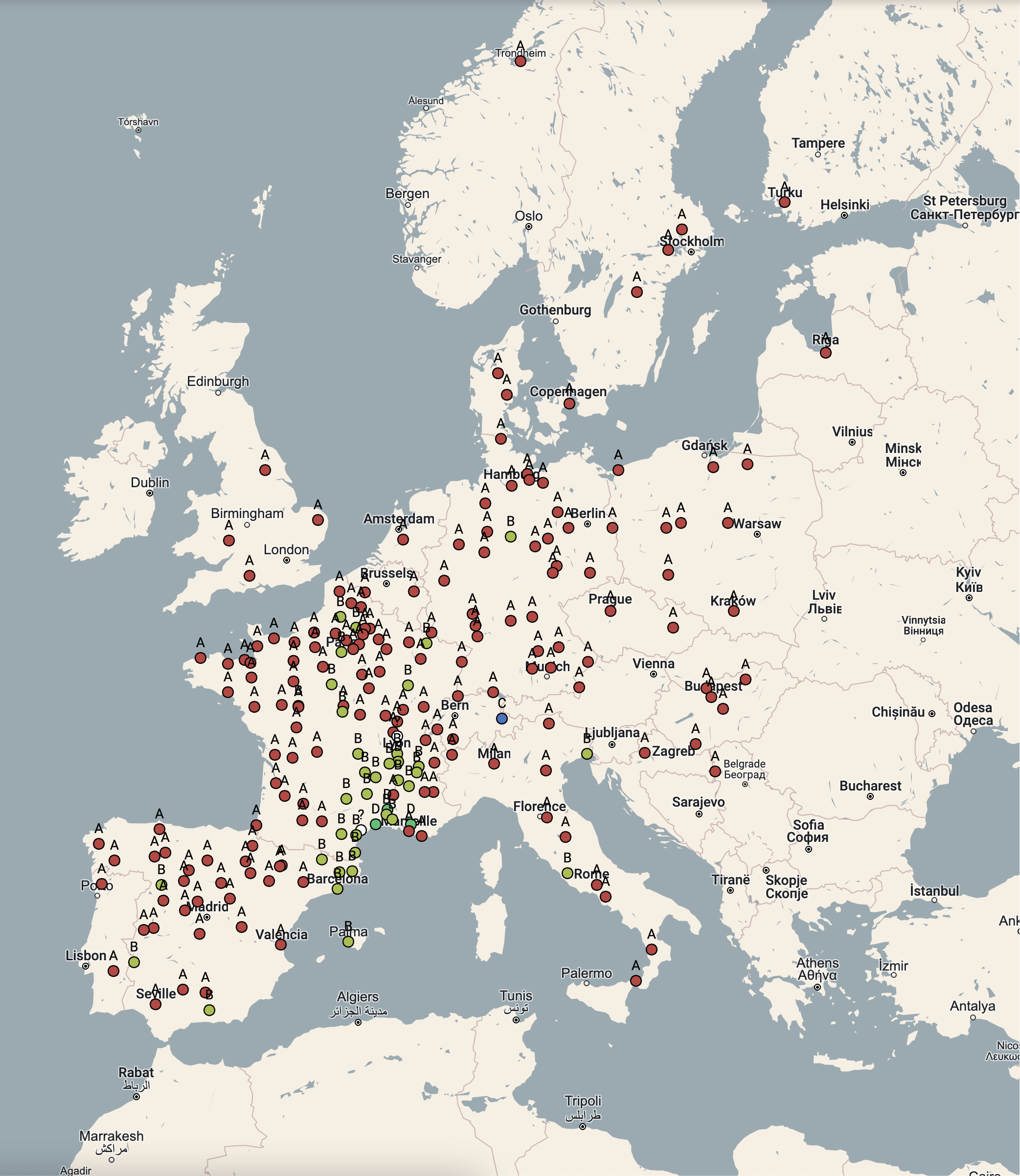
Notably, the use of Rome prescribes the use of Rorate cæli for the Fourth Sunday in Advent, with a number of sources in southern France and the Rhône following Roman use, as is typical, and the assignation of Rorate cæli for this Sunday continuing into the 1570 Missale Romanum, thus supplanting Memento nostri throughout most of the Western Church. Let this serve, yet again, as a reminder that the Missale Romanum of any era is not a reliable source for ascertaining the broad consensus of the pre-Tridentine liturgical practice of Western Christendom.
The Introit Rorate cæli did, however, have a significant place in western liturgical use apart from the Fourth Sunday in Advent. It is universally found on Ember Wednesday in Advent, in conjunction with the reading of the account of the Annunciation; in the votive mass of the Blessed Virgin Mary in Advent, commonly known as the Rorate mass (drawing many of its texts from the aforementioned Ember Wednesday mass); and on the Feast of the Annunciation itself. The Rorate mass was so immensely popular, in fact, that the 1613 Cantica Sacra of the Lutheran Cathedral of Magdeburg appointed its gradual texts for every Sunday in Advent alongside the usual readings, with the proper Sunday masses relegated to the following weekdays.
While the presence of Rorate cæli for the Fourth Sunday in Advent in contemporary Roman use likely had some influence on the Common Service committee, the deciding factor was likely its presence in their two available Lutheran sources that provided an Introit for the day in question: Lossius’ Psalmodia and the Officium Sacrum of Nuremberg. As was mentioned above, the Rorate cæli text was beloved, and neither of these books includes the other occasions in Advent on which the Introit would have been sung, so it seems to have been moved to the Fourth Sunday in Advent rather than being lost altogether. In total, five of our Lutheran sources, including those three consulted by the Common Service editors, prescribe Rorate cæli for the Fourth Sunday in Advent, and all of them similarly lack the occasions in Advent on which that text would properly occur. (The other sources in question are Ludecus’ Missale of 1589 and the Lateinisches Gesangbuch from Zittau, 1729).
The Introit Memento nostri, in addition to its pre-Reformation ubiquity, also appears in a number of the most reliable Lutheran sources, including the Missale Germanicum of 1568, Jespersson’s Gradual of 1573, the 1613 Cantica Sacra of the Magdeburg Cathedral (though, as noted above, shifted to the weekdays following), and Franz Eler’s Cantica Sacra of 1588, as well as less prominent sources like the Skálholt Gradual, c. 1575. All of these sources provide the Introit Rorate cæli elsewhere, whether in Advent or on the feast of the Annunciation (or, in Eler’s case, on the feast of the Visitation), and so did not feel the need to preserve it by moving it to the Fourth Sunday in Advent. These sources are also broadly more conservative, and were loath to change the appointed texts unnecessarily.
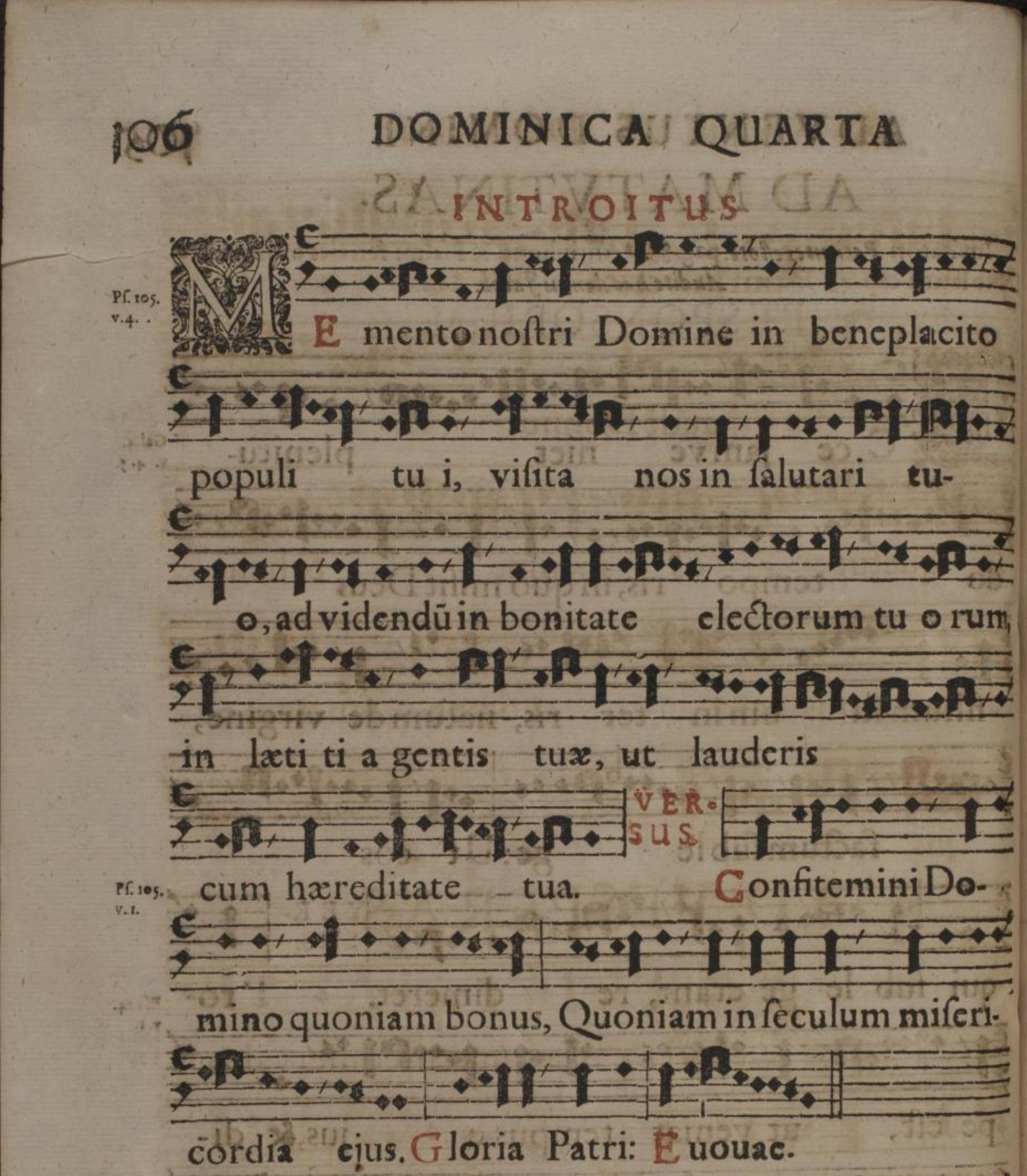
As a result, the proposed Introit for the Fourth Sunday in Advent in the Lutheran Missal is Memento nostri:
Remember us, O LORD, with the favor that Thou bearest unto Thy people: Oh, visit us with Thy salvation; that we may see the good of Thy chosen in the gladness of Thy nation, that we may glory with Thine inheritance. V: Oh, give thanks unto the LORD; for He is good: for His mercy endureth forever. Gloria Patri. (Ps. 106:4–5, 1b)
Discover more from The Lutheran Missal Blog
Subscribe to get the latest posts sent to your email.
The suggested Introits have the feel of Eastern Orthodox liturgy as opposed to Roman Catholic or Anglican. While they do add more colorful language to the liturgy, I feel they are too wordy and need editing. The ‘deleterious’ Preface of the BCP to me is preferable to the traditional.
Would you care to elaborate? The introits are, by and large, direct quotations from Holy Scripture in the Authorized (King James) Version, so I’m not quite understanding the connection with Eastern Orthodox liturgy.
Memento nostri is a curious shift.
Remember Me
Early – BHS Ps 106:4 “remember me, O Lord.”
Early – Vulgate Ps 105:4 “Remember me, O Lord…”
1545 – Luther Bible Ps 106:4 “Lord, remember me…”
1568 – Bishop’s Bible Ps 106:4 “Remember me, O God…” (odd de-YHWHizing)
1599 – Geneva Ps 106:4 “Remember me, O Lorde…”
1611 – KJV Ps 106:5 “Remember me, O LORD…”
Remember Us
Early – LXX Ps 105:4 “remember us, O Lord….”
1382 – Wycliffe Ps 105:4 “Lord, haue thou mynde on vs…”
1582 – Douay Rheims Ps 106:4 “remember us, O Lord…”
Do you know what text tradition the Germans were using?