Uncovering the Historic Lectionary
“Where no counsel is, the people fall: but in the multitude of counselors there is safety.”
(Proverbs 11:14)
The Church’s lectionary is not the product of a committee. It did not originate in response to a synodical resolution or a papal directive. Rather, it was created and refined by an organic process that spanned generations of believers. We call it the “historic lectionary” because in some form it has been in continuous use by the Church for the last fifteen-hundred years and probably longer. Indeed, as early as the first century, the Church was celebrating Easter, which soon became Easter and Pentecost, and then Epiphany, Lent, Easter, and Pentecost, and so on…
Publishing the Historic Lectionary is tricky, however. There is no one manuscript containing the official Historic Lectionary. Like any true tradition, it had taken root long before anyone thought to document its existence. As a further complication, just as the lectionary continued to evolve organically, so did the traditions peculiar to each locality. Thus, the missals of medieval Europe each contain a liberal dose of local customs mixed with the tradition common to the whole Church. In my study of these missals, I would venture to guess that up to 25% of the content may be unique to the city or diocese of origin.
How can we discern between local peculiarities and our common heritage? In much the same way that the textual critics compare dozens of manuscripts to identify scribal additions and copyist errors in the biblical facsimiles. Our initial task in preparing The Lutheran Missal is to peel away the layers of local oddities and “uncover” the Historic Lectionary beneath. The more sources we consult, the more confident we can be of the result.
Let me give an example. Based on the three missals shown below, what is the historic Epistle reading for Friday of Ad Te Levavi?

From the data above, Zechariah would appear to be the right choice. However, a larger pool of sources tells a different story:
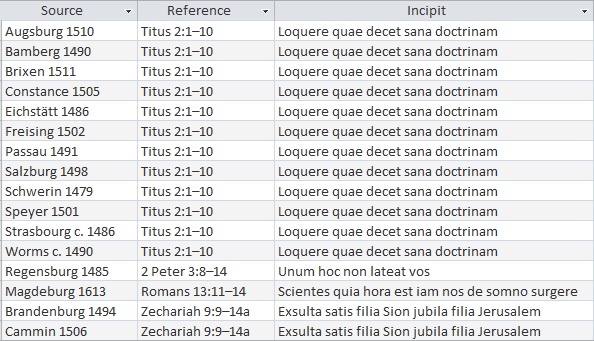
It is clear that Titus 2, not Zechariah, is to be preferred—particularly when one considers that Cammin was under Brandenburg rule during this time period. By cataloging the contents of the thirty-four German missals within our chosen data-set, we hope to endow the Church with the most faithful presentation of the entire Historic Lectionary ever published in any language.
NOTE: The sources are nearly unanimous on Sundays and major feast days. Thus The Lutheran Missal will largely agree with that portion of the Historic Lectionary contained in our existing lectionary books.
Discover more from The Lutheran Missal Blog
Subscribe to get the latest posts sent to your email.