Lections
For several months we have been hard at work assigning scripture references to every lection in our sources—32,780 (lections) at present count. Some readings include the whole Latin or German text, while others give only a few words. In many cases extra detective work is required to determine which reading is intended by a given incipit. For example, to which of the ten texts below does the following incipit belong?
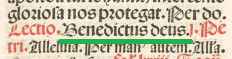
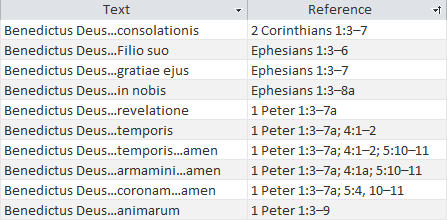
The rubric indicates that the reading is from 1 Peter, but that still leaves six possibilities. After finding and examining the full text from 1 Peter elsewhere in this missal, we were able to determine that Benedictus Deus…revelatione was the intended reading. Between the ten texts above, there were 180 incipits that had to be sorted in this way.
To continue with our example, these ten texts can be further grouped into text “families.” The six variations of 1 Peter are, in effect, the same text—likewise, the three from Ephesians. 180 incipits boil down to ten texts, and these can be reduced to three text families. In this way we can begin to make sense out of our mountains of data.
Here is a visual example from the Epistle for the Dedication of an Altar:
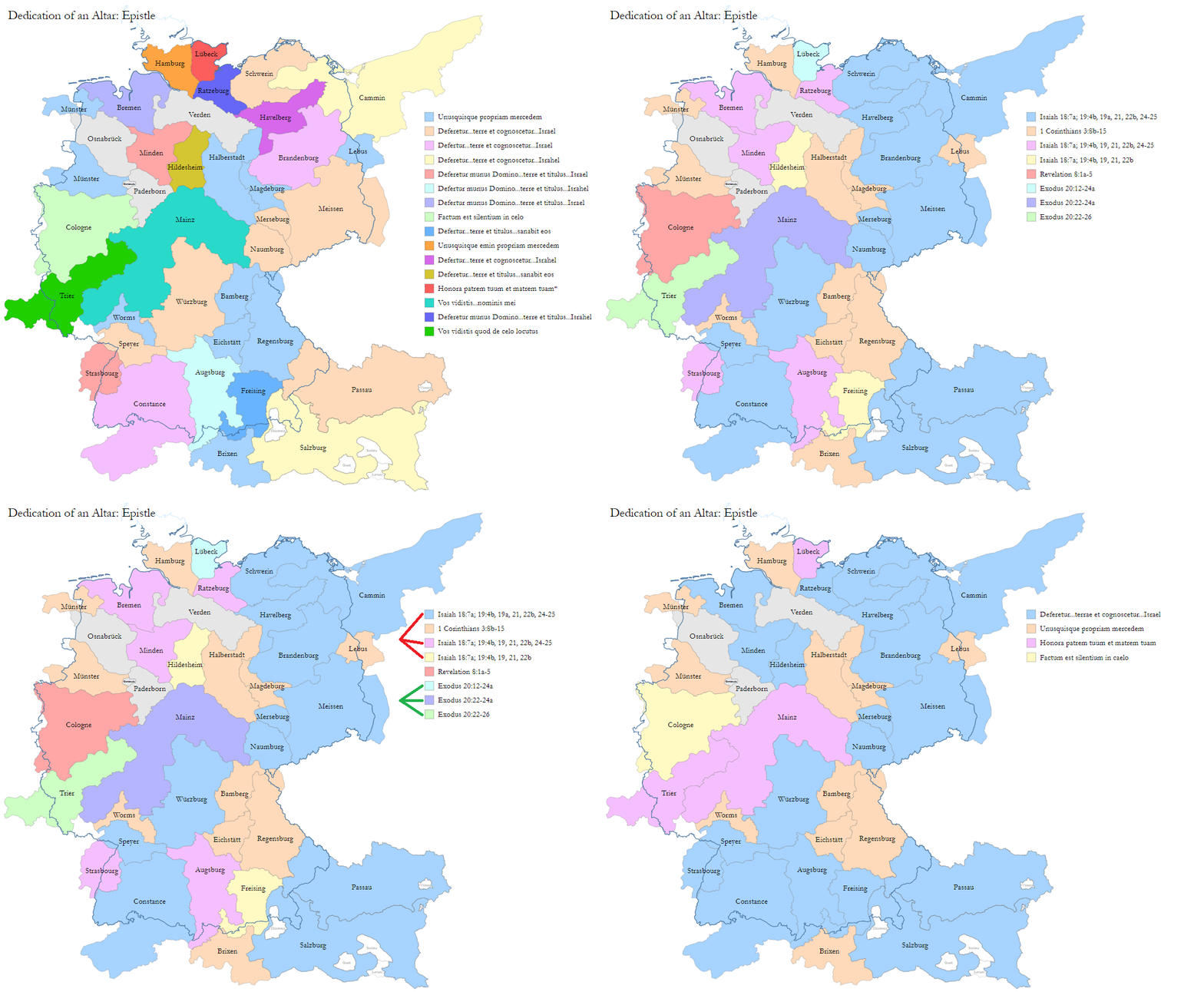
It would very difficult to make an informed decision with the jumble of sixteen different incipits first pictured. But these correspond to eight unique texts with bible references, which, in turn, are derived from four text families: Isaiah 18ff, 1 Corinthians 3, Exodus 20, and Revelation 8. Of these four, only Isaiah 18 and 1 Corinthians are widely attested. We’re not at the editing stage yet, but it does seem likely that Isaiah will be our reading, possibly with 1 Corinthians as an alternate.
With this explanation of what we’ve been doing, I’m pleased to announce that all the lections are finished: 32,780 Incipits > 1,392 Texts > 957 Text Families. Certainly, not all of these texts will appear in The Lutheran Missal. Some are only found in one source for a very minor occasion. Even so, the basic framework of the true historic lectionary is beginning to take shape. Below is a chart of lections for the first four chapter of Matthew:
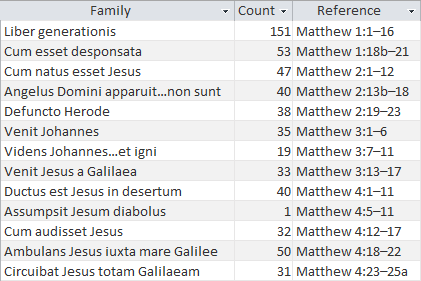
All of these readings save one are well attested (see the Count column), and they cover about 99% of the material in Matthew so far. It’s too early to try to make a comparison with the modern three-year lectionary, but I am optimistic that when the historic lectionary is fully restored it will include more of the New Testament, though less of the Old, given that most occasions have only a Gospel and Epistle reading.
Meanwhile our work continues. What has been done for the lections must also be done for the verses and prayers. May God grant us swift success.
Discover more from The Lutheran Missal Blog
Subscribe to get the latest posts sent to your email.
I just came onto this site and would be pleased, at this late date, to help in any way.
(I am not capable of dealing with German, but better with Latin or Koine Greek.).
I am fine with routine tasks.
Fraternally yours,
Fr. Jim Cavener (coastcurate).